
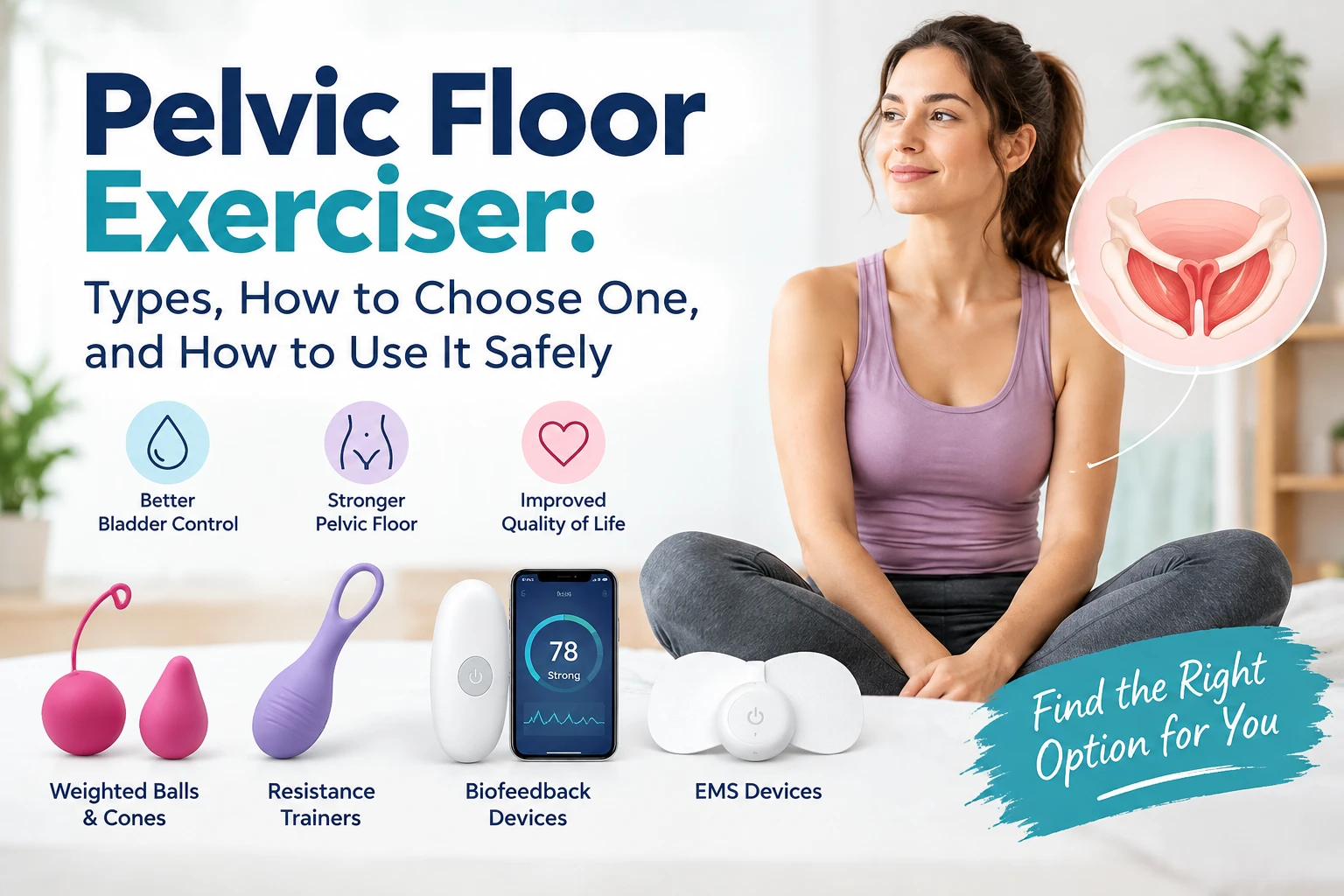
Search for a pelvic floor exerciser and you’ll find everything from weighted balls to app-connected sensors to electrical stimulation machines, many of them promising dramatic results. It’s no wonder shoppers feel confused. Some devices help you build strength, others help you learn what a correct contraction feels like, and others stimulate the muscles for you. The right choice depends on what’s actually going on in your pelvic floor, and sometimes the right choice is to see a physical therapist first.
This guide explains what a pelvic floor exerciser is, what research says about pelvic floor training, the main device types and who each suits, how to choose, and how to use one safely. We’ll also point out marketing claims to be skeptical of.
Key takeaways
- Pelvic floor muscle training is well supported for urinary leakage, but evidence that any particular device beats good training is limited.
- The main types are weighted balls or cones, resistance trainers, biofeedback devices, and electrical stimulation (EMS) devices.
- Weak and tight pelvic floors need different approaches, so identify which pattern fits you before buying.
- Be wary of claims like “clinically proven” without cited evidence, and check contraindications such as pregnancy and implanted devices.
- If you have pain, a bulge, or worsening symptoms, see a clinician before using any device.
What Is a Pelvic Floor Exerciser?
A pelvic floor exerciser is any tool designed to help you train the muscles that support your bladder, bowel, and (in women) uterus. These muscles form a hammock from the pubic bone to the tailbone, and the Cleveland Clinic explains that they help control urination and bowel movements and contribute to sexual function.
Devices are sometimes called pelvic floor trainers, Kegel exercisers, or pelvic toners. Some are inserted internally, some use external pads, and some simply provide feedback through an app. Their goal is the same: to make pelvic floor training easier, more consistent, or more accurate than doing it unaided.
Do Pelvic Floor Exercisers Actually Work?
Here’s the honest picture. Pelvic floor muscle training, which means repeated, correctly performed contractions and releases, has strong support. A major Cochrane review concluded that women with stress urinary incontinence who did pelvic floor muscle training were substantially more likely to report cure or improvement than those who did not, with fewer leakage episodes. The review’s authors suggested this training be part of first-line conservative management, a conclusion echoed in its PubMed abstract.
But there are important caveats:
- The research is about training, not about any specific gadget. A separate Cochrane comparison of training approaches found insufficient evidence to recommend one approach as best, though it noted that more supervision tended to help people report improvement.
- Results depend on technique and consistency. Doing exercises incorrectly, or doing contraction-only work when your pelvic floor is tight, can limit results or worsen symptoms.
- Devices are tools for delivering training. They can help some people stay consistent or get feedback, but they aren’t magic, and they aren’t a substitute for a diagnosis.
The Mayo Clinic’s Kegel guide describes how strengthening these muscles can help with bladder control, and it stresses finding the right muscles and not overdoing it.
The 4 Main Types of Pelvic Floor Exerciser
1. Weighted Balls and Cones
These are small weights, often silicone-coated, that you hold in place using your pelvic floor. The weight provides gentle resistance and a physical cue that you’re engaging the right muscles. Our Kegel exercise balls are an example of this category.
Best for: people who can already feel and isolate their pelvic floor and want progressive resistance. Watch for: the temptation to “grip” with your thighs or abdomen, and to overuse without rest.
2. Resistance and Squeeze Trainers
These devices, often with springs or compressible silicone, give you something to squeeze against, adding resistance to contractions. Some provide visual or numeric feedback.
Best for: people who want a simple, low-tech tool for strengthening. Watch for: the fact that squeezing tools train contraction, not release, so they’re not ideal if you suspect a tight pelvic floor.
3. Biofeedback Devices
Biofeedback devices sense muscle activity and display it on a screen, light, or app so you can see whether you’re contracting correctly and how strong the contraction is. Our pelvic floor biofeedback probe is a universal accessory designed to work with compatible devices that use standard connecting wires.
Best for: people who aren’t sure they’re engaging the right muscles, or who want to learn what a full release looks like. Watch for: compatibility. Check that the probe or sensor matches your base unit.
4. Electrical Muscle Stimulation (EMS) Devices
EMS devices send low-level electrical pulses through an internal probe or external pads to trigger muscle contractions. Examples on our site include the TPFHealth Electronic Pelvic Toner and the low-frequency pulse pelvic floor machine, which also offers biofeedback and diastasis recti training modes.
Best for: people who struggle to feel or voluntarily contract the muscles, with appropriate guidance. Watch for: contraindications. Manufacturers typically advise against use in pregnancy, with pacemakers or other implanted electronic devices, with certain heart conditions or epilepsy, over unhealed wounds, and during heavy menstruation. Because EMS triggers contraction, it may not suit someone with a tight or painful pelvic floor.
Comparison Table
| Type | How it works | Good for | Main caution |
|---|---|---|---|
| Weighted balls/cones | Weight adds passive resistance while you contract | Building strength once you can isolate the muscles | Easy to compensate with other muscles |
| Resistance/squeeze trainers | You squeeze against springs or silicone | Simple strengthening | Doesn’t train release |
| Biofeedback | Sensor shows muscle activity | Learning correct technique, including relaxation | Compatibility and interpretation |
| EMS | Electrical pulses trigger contractions | Difficulty feeling or contracting the muscles | Contraindications; may not suit tight pelvic floor |
For a side-by-side view of our devices, visit our comparison page, or read our complete guide to pelvic floor therapy devices.
Weak or Tight? Decide Before You Buy
Most advice assumes a weak pelvic floor, but some people have the opposite problem: muscles that are chronically over-contracted. Typical signs of tightness include pelvic pain or pressure, pain with intercourse, difficulty emptying the bladder, constipation, or urgency without much leaking. Typical signs of weakness include leaking with coughing, sneezing, or exercise.
Why it matters: a squeezing-based exerciser or an EMS device adds contraction. For a tight pelvic floor, that can increase tension. If you suspect tightness, start with relaxation work and a professional assessment. Our guides to tight pelvic floor symptoms and pelvic floor stretches explain what to look for and how to begin.
How to Choose the Right Pelvic Floor Exerciser
Use this checklist:
- Match the device to your goal. Strength? Technique feedback? Help contracting at all?
- Know your pattern. Weak, tight, or unsure? When unsure, favor feedback and assessment over more contraction.
- Consider your stage of life. Pregnancy and early postpartum have special considerations. See our guides to physical therapy during pregnancy and postpartum physical therapy.
- Check safety information. Look for clear contraindications, instructions, and materials (body-safe silicone or medical-grade plastic). Certifications such as CE relate to safety standards, not proof the product works.
- Look for realistic claims. Be cautious with promises of dramatic results in days, or claims like “clinically proven” with no study to read.
- Think about cleaning. Internal devices should be easy to wash and dry. Follow the manufacturer’s instructions, and avoid boiling or sterilizing anything not designed for it.
- Consider comfort and fit. Size, shape, and ease of use affect whether you’ll use it consistently.
- Check support and returns. A clear return policy and responsive support matter for an intimate device.
How to Use a Pelvic Floor Exerciser Safely
Always follow your specific device’s instructions. As a general framework:
- Get clearance if needed. If you’re pregnant, recently postpartum, post-surgery, or have pain, bleeding, or a known condition, talk to your provider first.
- Prepare and clean. Wash your hands and clean the device as directed. Use a compatible lubricant or conductive gel if the instructions call for it.
- Start in a comfortable position. Lying down is usually easiest for beginners.
- Begin at low intensity or light resistance. More isn’t better early on.
- Focus on technique. Breathe normally, keep your abdomen, glutes, and thighs relaxed, and aim for a gentle lift rather than a hard squeeze.
- Include full relaxation. Release completely between contractions. Our guide to signs you’re doing Kegels wrong covers the most common technique errors.
- Keep sessions short and consistent. Short, regular sessions (often 10 to 30 minutes depending on device type, a few times per week) are common recommendations, but follow your device’s guidance.
- Stop if something hurts. Mild sensation can be normal, but sharp pain, burning, or ongoing discomfort isn’t.
- Clean and dry afterward. Store the device in a clean, dry place.
Common Mistakes
- Buying before understanding your symptoms. The wrong device type can waste money or worsen tension.
- Compensating with other muscles. If your abs, glutes, or thighs do the work, you’re not training the pelvic floor.
- Overtraining. Muscles need recovery time like any other.
- Ignoring relaxation. A pelvic floor that can’t release can cause problems.
- Skipping the basics. A device doesn’t replace learning correct technique.
- Using a device with contraindications. Check pregnancy, implants, infections, and other warnings.
Choosing a Pelvic Floor Exerciser at Different Life Stages
After childbirth. Many people look for a pelvic floor trainer postpartum, but timing matters. Healing from tearing, an episiotomy, or a cesarean, plus hormonal changes while breastfeeding, can affect comfort and what’s appropriate. Wait for your provider’s clearance, and consider starting with an assessment. Our postpartum pelvic floor recovery timeline shows what typically happens at 2, 6, and 12 weeks.
Around and after menopause. Falling estrogen can change tissue comfort and elasticity, and some people notice new urgency or leaking. Devices may still play a role, but comfort, lubrication, and gentle progression become more important. If you have dryness or pain, discuss it with your clinician before starting.
For active people. Runners, lifters, and high-impact athletes sometimes leak during exercise or feel pelvic heaviness. A device can help build awareness, but an assessment can reveal whether strength, coordination, or load management is the real issue.
With diastasis recti or core weakness. The abdominal wall and pelvic floor work together, so training one without the other may fall short. Our article on diastasis recti and the pelvic floor explains how the two relate, and why research on the link is mixed.
What to Expect in Your First Month
Setting realistic expectations helps you stay consistent. In the first week or two, most people are simply learning the device, finding a comfortable position, and noticing which muscles they’re using. During weeks three and four, awareness usually improves, and you may feel more control, though meaningful symptom changes often take longer. Keep a short log of sessions, intensity, and symptoms, since patterns are easier to spot on paper than from memory. If symptoms worsen, or nothing changes after consistent use for around 12 weeks, book an assessment instead of simply increasing intensity.
Marketing Claims to Be Skeptical Of
Because this category is crowded, a few red flags are worth knowing:
- “Clinically proven” with no citation. Look for named studies, not vague phrases.
- “Cures” or “treats” medical conditions. Consumer wellness devices generally can’t promise to treat disease.
- Dramatic timelines such as “results in 7 days.”
- Missing contraindications. Reputable products clearly list who shouldn’t use them.
- Vague regulatory language. Understand what a certification actually covers. For example, CE certification and electrical safety testing relate to safety compliance, not clinical effectiveness.
We aim to describe our products accurately, and we encourage you to read the full specifications and safety information on each product page before deciding.
When to See a Pelvic Floor Physical Therapist First
A professional assessment is especially worthwhile if you have:
- Pelvic pain, burning, or pain with intercourse
- A feeling of bulging, heaviness, or pressure in the vagina or rectum
- Leaking that is increasing despite training
- Difficulty emptying your bladder or bowels
- Recent childbirth or pelvic surgery
- Uncertainty about whether you’re weak, tight, or both
Evidence suggests that guidance matters. Because a therapist can determine the pattern and teach technique, many people find a device works better as part of a plan than as a standalone purchase. The Academy of Pelvic Health Physical Therapy maintains a PT Locator directory to help you find a therapist.
Frequently Asked Questions
What is the best pelvic floor exerciser for beginners?
It depends on whether you can already feel and isolate your pelvic floor. If you’re unsure, a biofeedback tool or professional guidance helps confirm technique. If you can contract the muscles confidently, weighted balls or a simple resistance trainer are common starting points.
Do pelvic floor exercisers really work?
Cochrane research shows strong evidence that pelvic floor muscle training helps urinary incontinence in women. Evidence that any particular device outperforms well-performed exercises is limited, so devices are best seen as tools to support training.
Can I use a pelvic floor exerciser every day?
Many routines suggest a few sessions per week rather than daily use, especially for electrical stimulation, to allow muscle recovery. Follow your device’s instructions and your clinician’s advice.
Are pelvic floor exercisers safe during pregnancy?
Not necessarily. Electrical stimulation devices are generally not recommended in pregnancy, and any internal device should be approved by your obstetric provider first. See our article on physical therapy during pregnancy.
How long does it take to see results?
Timelines vary with your starting strength, consistency, and underlying cause. Many sources suggest weeks to a few months of regular practice. If you see no improvement after about 12 weeks, consider a professional assessment.
Can a pelvic floor exerciser make things worse?
It can if used incorrectly, overused, or used when the pelvic floor is already tight. Stop if you notice increasing pain, pressure, or worsening symptoms, and seek an assessment.
Is an electronic pelvic floor exerciser better than Kegel balls?
Neither is automatically better. EMS devices can help people who struggle to contract the muscles, while balls rely on your own voluntary contractions and can build active control. Many people benefit from combining approaches under guidance.
Can men use a pelvic floor exerciser?
Some devices are designed for female anatomy only. Men interested in pelvic floor training should check the intended use of any device and consider consulting a pelvic health specialist.
How do I clean a pelvic floor exerciser?
Typically with warm water and mild soap, then fully air-dried, but follow the manufacturer’s instructions. Avoid boiling or sterilizing unless the product states it’s safe.
