
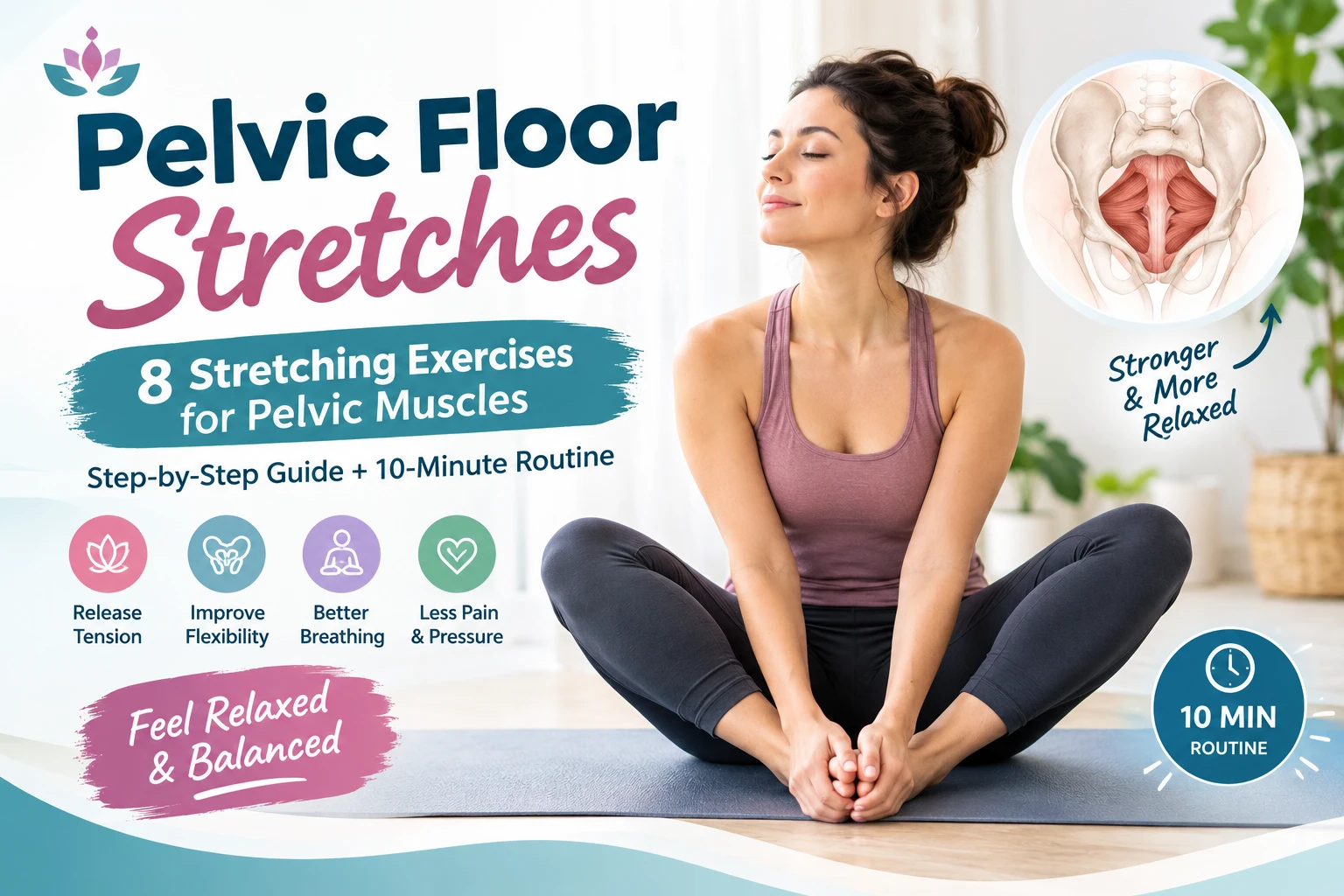
Most pelvic floor advice is about squeezing harder. Do your Kegels, hold the contraction, build strength. But strength is only half of a healthy pelvic floor. The other half is the ability to let go: to lengthen, release, and relax on demand. When that second half is missing, you can end up with pelvic pressure, pain during sex, a hesitant bladder stream, or a constant sense of clenching, no matter how many repetitions you do.
This is where a pelvic floor stretch routine comes in. Gentle stretching exercises for pelvic muscles, paired with slow breathing, help the muscles and the surrounding hips, glutes, and lower back release tension they’ve been holding. This guide covers eight beginner-friendly stretches, a 10-minute routine, safety guidance, and how stretching fits alongside strengthening.
Quick takeaways
- Pelvic floor stretches focus on relaxation and lengthening, not squeezing.
- Breathing is the foundation: the diaphragm and pelvic floor move together.
- Gentle and consistent beats deep and forceful. Never stretch into sharp pain.
- If you have pain, pressure, or a bulge, get assessed by a pelvic floor physical therapist before self-treating.
What Do Pelvic Floor Stretches Actually Do?
Your pelvic floor is a hammock of muscles running from the pubic bone to the tailbone, supporting the bladder, bowel, and (in women) the uterus. According to the Cleveland Clinic’s overview of the pelvic floor muscles, these muscles help control urination and bowel movements and play a role in sexual function, which is why tension or dysfunction here can show up in so many different ways.
Like any muscle group, the pelvic floor can become overworked and tight. Stress, prolonged sitting, intense core training, and scar tissue after childbirth can all contribute. The Cleveland Clinic describes hypertonic pelvic floor as a state in which the muscles are in constant contraction or spasm, and notes that relaxation techniques are part of the treatment picture.
Stretching and release work aims to:
- Lengthen muscles that are shortened or overactive
- Improve awareness of what “relaxed” feels like, which many people have never consciously felt
- Ease tension in neighbors: tight hips, glutes, and lower back can keep the pelvic floor on high alert
- Prepare the pelvic floor for strengthening, since a muscle that can’t fully relax often can’t contract well either
Who Should Try Pelvic Floor Stretches?
Stretching-focused routines are commonly useful for people who:
- Have been told, or suspect, they have a tight pelvic floor (see our guide to tight pelvic floor symptoms)
- Experience pelvic pressure or aching, especially after long periods of sitting
- Notice discomfort during intercourse or difficulty relaxing during an internal exam
- Sit at a desk most of the day
If leaking with coughing or sneezing is your only symptom, weakness may be the bigger factor. Many people have a mix of both, so read this alongside our guide on signs you’re doing Kegels wrong.
Before You Start: Safety and Setup
A few ground rules make these stretches safer and more effective.
- Go gentle. A good stretch feels like mild lengthening, never sharp or burning. If something hurts, ease off.
- Breathe through every position. Holding your breath tends to clench the pelvic floor, the opposite of what you want.
- Warm up. Stretch after a warm shower or short walk, when muscles are more pliable.
- Know when to pause. Skip or modify stretches and check with a clinician if you:
- Are pregnant, or in the first weeks after birth or surgery, and haven’t been cleared for exercise
- Have diagnosed pelvic organ prolapse (deep squats and some positions may need modification)
- Have severe pelvic pain, unexplained bleeding, or signs of infection
- Feel numbness, tingling, or radiating pain during any stretch
The Foundation: Diaphragmatic "Belly" Breathing
Before any stretch, learn this breath. Your diaphragm and pelvic floor move in a rhythm: when you inhale, the diaphragm lowers and the pelvic floor gently expands and descends; when you exhale, both lift back up. Physical therapists often teach this first, and resources such as Hinge Health’s guide to hypertonic pelvic floor exercises describe diaphragmatic breathing as a core part of relaxation training.
How to do it:
- Lie on your back with knees bent and feet flat, or sit comfortably supported.
- Rest one hand on your upper chest and one on your lower ribs or belly.
- Inhale slowly through your nose for about four seconds. Let your belly and lower ribs expand outward, and imagine the pelvic floor softening and dropping like a gentle bloom.
- Exhale slowly through pursed lips for about six seconds, without forcing or squeezing.
- Repeat for five to ten breaths.
If the hand on your chest moves more than the hand on your belly, slow down and try again. Do a round of belly breathing before and during each stretch below.
8 Gentle Stretching Exercises for Pelvic Muscles
1. Child's Pose
Targets: lower back, hips, and the posterior pelvic floor
- Start on hands and knees. Spread your knees wide, with big toes touching.
- Sit your hips back toward your heels as far as is comfortable.
- Lower your torso between your thighs and rest your forehead on the floor, a pillow, or stacked fists.
- Let your arms rest forward or alongside your body.
- Breathe into your lower back and sit bones for 5 to 10 slow breaths, imagining the pelvic floor widening on each inhale.
2. Happy Baby Pose
Targets: inner thighs, hips, and the pelvic floor
- Lie on your back with knees bent.
- Draw your knees toward your armpits and hold the outsides of your feet, or your shins if that’s more comfortable.
- Let your knees open wider than your torso, ankles stacked over knees.
- Keep your tailbone heavy on the floor and rock gently side to side if it feels good.
- Breathe slowly for 5 to 10 breaths, allowing your pelvic floor to soften with each inhale.
3. Supported Deep Squat (Malasana)
Targets: pelvic floor, hips, adductors, and ankles
- Stand with feet slightly wider than hip-width, toes turned out.
- Lower into a squat as deep as is comfortable. Place a rolled towel under your heels or sit on a yoga block or low stool if you can’t keep your heels down.
- Press your palms together at your chest and gently use your elbows to open your knees.
- Keep your spine long and breathe into your lower belly for 5 to 8 breaths.
Caution: Deep squats increase downward pressure on the pelvic floor. If you have diagnosed prolapse, ask your clinician before using this position, or practice it with generous support and a shallower depth.
4. Seated Butterfly Stretch
Targets: inner thighs, groin, and hips
- Sit tall with the soles of your feet together and knees dropped open. Sit on a folded blanket if your lower back rounds.
- Hold your ankles or feet and keep your spine long.
- Hinge forward slightly from the hips, only as far as feels like gentle lengthening.
- Breathe slowly for 30 to 60 seconds. Let your knees sink naturally, without pressing them down.
5. Cat-Cow
Targets: spine, pelvis mobility, and coordination between breath and pelvic floor
- Start on hands and knees, wrists under shoulders and knees under hips.
- As you inhale, let your belly drop and your tailbone tilt up (cow), allowing the pelvic floor to soften.
- As you exhale, gently round your spine and tuck your tailbone (cat), without forcing a tight squeeze.
- Move slowly with your breath for 8 to 10 rounds.
6. Supine Figure-4 Stretch
Targets: glutes, piriformis, and deep hip rotators that connect closely with the pelvic floor
- Lie on your back with knees bent and feet flat.
- Cross your right ankle over your left thigh, just above the knee, forming a “4.”
- Thread your hands behind your left thigh and gently draw it toward your chest until you feel a stretch in your right glute.
- Keep your head and shoulders relaxed. Breathe for 30 to 60 seconds, then switch sides.
7. Kneeling Hip Flexor Stretch
Targets: hip flexors and the front of the pelvis
Tight hip flexors can tilt the pelvis forward and keep the pelvic floor under constant tension, especially in people who sit for long hours.
- Kneel on your right knee on a cushion, with your left foot forward in a lunge.
- Tuck your tailbone gently under, as if lengthening your lower back.
- Shift your weight slightly forward until you feel a stretch at the front of your right hip.
- Keep your ribs stacked over your pelvis. Don’t arch your lower back.
- Hold for 30 to 45 seconds with slow breaths, then switch sides.
8. Reverse Kegel (Pelvic Floor Drop)
Targets: conscious release of the pelvic floor itself
This isn’t a stretch in the traditional sense, but it’s one of the most useful relaxation skills to learn. Physical therapists sometimes call it “down-training.”
- Lie on your back with knees bent, or sit comfortably.
- Take a slow belly breath in.
- As you inhale, imagine your pelvic floor gently widening and dropping toward the surface beneath you, like a flower opening. Don’t bear down or push.
- As you exhale, allow the muscles to remain soft, without squeezing.
- Repeat for 5 to 10 breaths.
A reverse Kegel should feel subtle and easy. If you notice straining, you’re pushing too hard.
A Simple 10-Minute Pelvic Floor Stretch Routine
If you’re not sure where to begin, try this sequence, ideally in the evening or after a warm shower.
| Step | Stretch | Time |
|---|---|---|
| 1 | Diaphragmatic belly breathing | 1 minute |
| 2 | Cat-Cow | 1 minute |
| 3 | Child's Pose | 1.5 minutes |
| 4 | Kneeling Hip Flexor Stretch | 1.5 minutes (both sides) |
| 5 | Supine Figure-4 | 2 minutes (both sides) |
| 6 | Happy Baby | 1.5 minutes |
| 7 | Reverse Kegel with breathing | 1.5 minutes |
You can add the seated butterfly or supported squat on days when you have extra time and feel comfortable.
How Often Should You Stretch Your Pelvic Floor?
For most people, a short daily practice of 5 to 10 minutes works better than an occasional long session. Consistency helps the nervous system “learn” that it’s safe to release tension. Some people also benefit from a few mini-sessions through the day, such as 5 belly breaths at your desk or before bed.
Expect gradual change over several weeks. If symptoms stay the same or worsen after 4 to 6 weeks of consistent practice, it’s time for an in-person assessment rather than more guessing.
Stretching vs. Strengthening: You Probably Need Both
Here’s an important nuance: a pelvic floor that’s tight is not necessarily a pelvic floor that’s strong. Tight muscles can still be weak or uncoordinated.
The Mayo Clinic’s guidance on Kegel exercises emphasizes that Kegels strengthen the muscles that support pelvic organs and help with bladder control. Likewise, the NIDDK’s overview of bladder control problems describes pelvic floor training as a common part of managing urinary leakage. But for people with an overactive pelvic floor, jumping straight into repeated squeezing without first learning to relax can backfire.
A sensible approach for many people:
- Learn to relax first. Use breathing, stretching, and reverse Kegels to find a true resting state.
- Then strengthen with quality, not quantity. Add short, controlled contractions with full relaxation between each rep. Tools like our Kegel exercise balls can add gentle resistance once you’re confident in your technique.
- Confirm your technique. If you’re unsure whether you’re contracting or releasing properly, a biofeedback probe can show you in real time what your muscles are doing, which is especially helpful for learning what a full release looks like.
- Alternate and balance. Many routines pair a few strengthening sets with a longer stretching and breathing cool-down.
Not sure which type of tool suits you? Our pelvic floor device comparison page breaks down resistance trainers, stimulation devices, and biofeedback tools side by side, and our complete guide to pelvic floor therapy devices explains when each makes sense. One caution: electrical stimulation triggers muscle contraction, so if you suspect you’re tight rather than weak, talk to a pelvic floor physical therapist before starting a stimulation program.
Pregnancy and Postpartum Considerations
Gentle stretching and belly breathing are often used during pregnancy, but some positions (like deep squats) may need modification, so follow your obstetric provider’s advice.
After birth, the timing of when to return to stretching, Kegels, or devices depends on your delivery type, healing, and clearance. Our postpartum pelvic floor recovery timeline walks through what’s typical at 2, 6, and 12 weeks. If you’re also dealing with abdominal separation, see our article on diastasis recti and the pelvic floor, since some stretches and core movements may need adjusting.
When Stretching Isn't Enough: See a Pelvic Floor Physical Therapist
Self-guided stretching is a safe starting point for many people, but it has limits. Consider booking an assessment with a pelvic floor physical therapist if you have:
- Persistent pelvic pain, burning, or pressure
- Leaking that is increasing rather than improving
- A feeling of bulging or heaviness in the vagina or rectum
- No improvement after 4 to 6 weeks of consistent practice
A specialist can assess whether your pelvic floor is overactive, underactive, or both, and use techniques that are difficult to replicate at home.
Frequently Asked Questions
What are the best stretching exercises for pelvic muscles?
Commonly recommended options include Child’s Pose, Happy Baby, the seated butterfly stretch, supported deep squat, cat-cow, supine figure-4, and a kneeling hip flexor stretch, all combined with slow diaphragmatic breathing. The best choice depends on your comfort, mobility, and any medical guidance you’ve received.
How do I relax my pelvic floor muscles quickly?
Start with slow belly breathing, letting your belly and pelvic floor expand on the inhale and soften on the exhale. Pair this with a gentle position such as Child’s Pose or Happy Baby, and use a warm shower or heat pack on the lower abdomen or back beforehand. Relaxation is a skill, so it improves with practice rather than a single session.
How long does it take for pelvic floor stretches to work?
It varies. Some people feel calmer or less tense after a single session, while meaningful changes in symptoms often take several weeks of consistent practice. If you see no improvement after 4 to 6 weeks, an in-person assessment is a good next step.
Should I do Kegels or stretches first?
If you suspect tension, pain, or difficulty relaxing, learn to relax first and add strengthening gradually. If you have clear weakness and no pain, you might start with strengthening while still including a relaxation component. A pelvic floor physical therapist can tell you which pattern fits you.
