
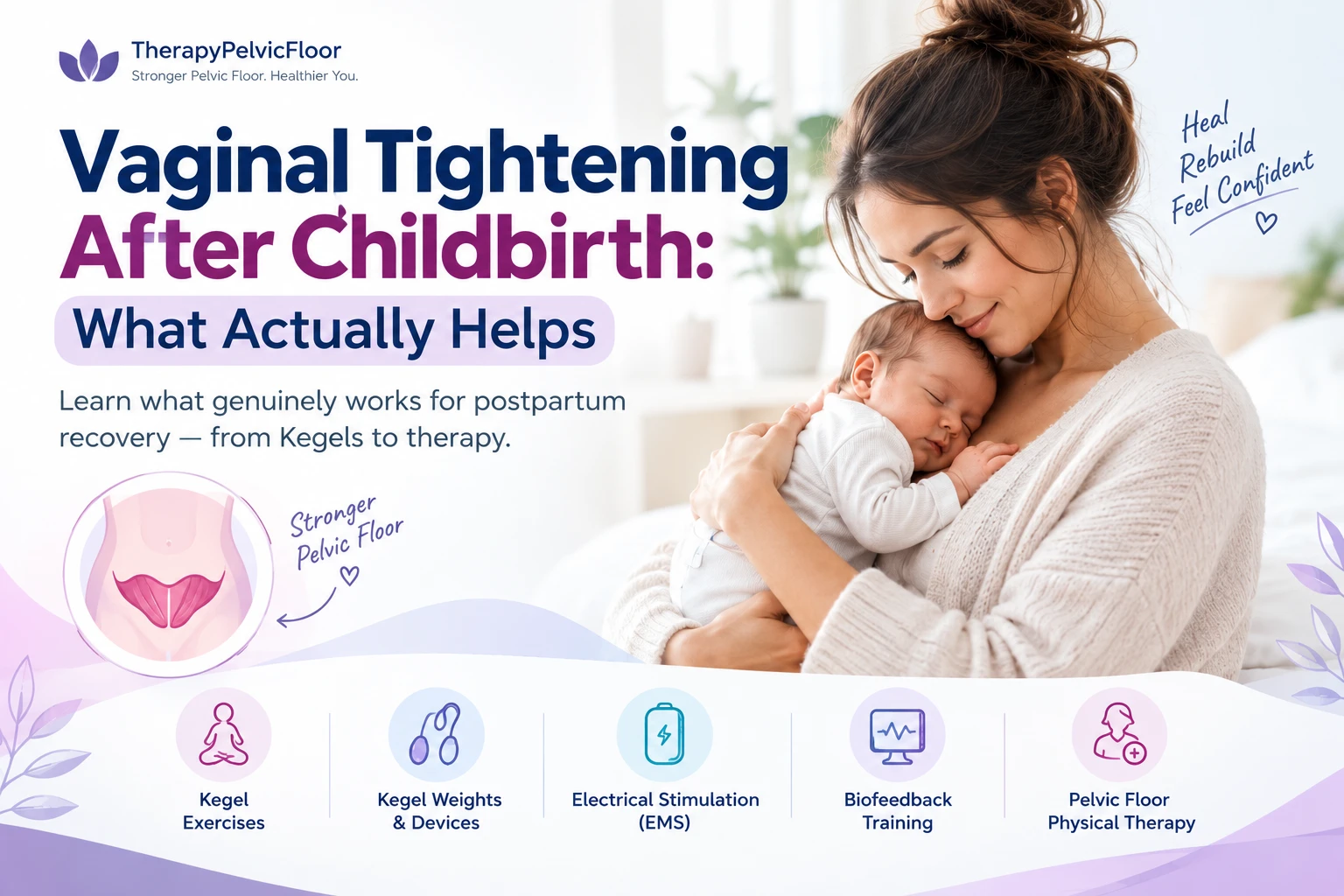
It’s one of those topics new moms think about a lot and talk about very little. Somewhere between recovering from delivery and adjusting to life with a newborn, a lot of women quietly notice that things feel different down there, looser, less toned, not quite the way they remember. It’s not vanity to wonder about this, and it’s definitely not something to feel embarrassed asking about.
Vaginal tightening after childbirth is a real, common concern, and thankfully, a well understood one. Pregnancy and delivery stretch the vaginal walls and the surrounding pelvic floor muscles considerably, and while the body does heal on its own to a degree, many women find that targeted exercises, tools, or in some cases professional therapy make a meaningful difference in how things feel afterward.
This guide walks through what’s actually happening physically after childbirth, which approaches genuinely help, and which claims floating around online are worth being skeptical of. At TherapyPelvicFloor, this is a question we field constantly, often in hushed, slightly hesitant messages, and it deserves a straightforward, judgment free answer.
There’s no need to feel awkward about wanting to know more. This is a physical, muscular issue with well documented causes and well documented solutions, not something mysterious or shameful, even though it rarely comes up in casual conversation the way other postpartum topics do.
Why Does Childbirth Affect Vaginal Tightness?
During vaginal delivery, the vaginal canal stretches dramatically to accommodate your baby, sometimes to several times its resting diameter. This is exactly what it’s designed to do, but that doesn’t mean the surrounding tissue simply snaps back to its previous state the moment delivery is over.
The pelvic floor muscles, which support and surround the vaginal walls, also stretch and weaken considerably during pregnancy and delivery. Since these muscles play a direct role in vaginal tone, weakened pelvic floor muscles often translate into a looser sensation, separate from the tissue stretching itself.
Hormones play a role too, one that’s easy to overlook. Relaxin, released during pregnancy to loosen ligaments in preparation for birth, affects connective tissue throughout the pelvic region, leaving things looser than usual for weeks or even months after delivery, regardless of how the baby was actually born. This effect gradually fades as hormone levels return to their pre-pregnancy baseline, which is part of why some natural improvement tends to happen even without any targeted intervention at all.
Even c-section deliveries aren’t fully exempt from this conversation. While there’s no direct vaginal stretching involved, the pregnancy itself still causes hormonal and muscular changes throughout the pelvic floor that can affect tightness and tone.
The number of vaginal deliveries also plays a role worth mentioning. Many women notice more pronounced changes after a second or third vaginal birth compared to their first, since cumulative stretching and muscle fatigue tend to build over multiple pregnancies rather than fully resetting between them.
Is This Normal, and Does It Improve on Its Own?
Yes, this is an extremely common postpartum experience, and to some extent, natural healing does improve things over the following months. The body has a genuine capacity to regain tone over time, particularly in the first six to twelve months postpartum, as hormone levels normalize and tissue gradually recovers.
That said, natural healing alone doesn’t always get women back to where they’d like to be, especially after a particularly difficult delivery, significant tearing, or multiple pregnancies. This is where targeted exercises and tools come in, not to replace the body’s own healing process, but to support and accelerate it.
It’s also worth saying that expecting things to feel identical to before pregnancy isn’t always realistic, and that’s okay. The goal for most women isn’t perfection, it’s meaningful, noticeable improvement that supports both physical comfort and confidence, which is genuinely achievable for the large majority of women who commit to consistent effort.
What Actually Helps With Vaginal Tightening
Pelvic Floor Exercises (Kegels)
Kegel exercises remain one of the most well supported, evidence backed approaches to improving vaginal tone postpartum. Since the pelvic floor muscles wrap around and support the vaginal canal, strengthening them directly improves the sensation of tightness, alongside the more commonly discussed benefits like bladder control.
Consistency is what actually drives results here, more than intensity. A few minutes of properly performed contractions, several times a day, tends to produce better outcomes over a few months than occasional, more intense sessions. If you’re unsure whether you’re engaging the correct muscles, our guide on how do you strengthen your pelvic floor walks through proper technique in detail.
It’s worth mentioning that a lot of postpartum women assume they’re doing Kegels correctly simply because they’ve done them before pregnancy, without accounting for the fact that muscle awareness genuinely changes after delivery. Taking the time to reconnect with these muscles from scratch, rather than assuming old habits still apply, tends to produce noticeably better results.
Kegel Weights and Resistance Devices
Weighted devices, like graduated Kegel balls, add resistance to your pelvic floor training, similar to how you’d progressively add weight in strength training for any other muscle group. As your strength improves, moving to a heavier weight continues to challenge the muscles, which tends to produce faster, more noticeable improvement than unweighted exercise alone.
Electrical Stimulation (EMS) Devices
Electrical muscle stimulation uses mild electrical pulses to trigger pelvic floor contractions directly, which can be particularly useful for women who struggle to consciously engage these muscles in the early postpartum period, when muscle awareness often hasn’t fully returned. Devices like the TPFHealth Electronic Pelvic Toner use this approach, and accessories like reusable electrode pads allow for consistent, comfortable use over repeated sessions.
Because these devices essentially do some of the initial muscle activation work for you, they’re often a helpful starting point for women who find manual Kegels difficult to feel or control in the months right after delivery. The gentle, rhythmic pulses also give the muscles a consistent, repeatable pattern of contraction and release that’s genuinely hard to replicate through willpower alone, especially in those early weeks when everything still feels unfamiliar.
Biofeedback Training
Biofeedback devices measure your muscle activity and display it in real time, so you can actually confirm whether you’re engaging the right muscles and how strong that contraction genuinely is. A pelvic floor biofeedback probe removes a lot of the guesswork that makes postpartum Kegels frustrating for a lot of new moms, particularly when muscle sensation still feels unfamiliar. For a lot of women, seeing the actual numbers or visual feedback change over a few weeks of practice is genuinely motivating in a way that unguided exercise simply isn’t.
Pelvic Floor Physical Therapy
For more significant concerns, particularly following a difficult delivery, significant tearing, or an episiotomy, working with a pelvic floor physical therapist offers a level of personalized assessment that home tools alone can’t fully replicate. A therapist can identify whether tightness training or scar tissue release work is the actual priority, since these are sometimes confused with each other but require very different approaches. Our guide on what happens during pelvic floor therapy covers exactly what to expect from a session.
Scar tissue in particular deserves its own mention here, since it’s an area home exercises genuinely can’t address on their own. Manual therapy techniques used by trained pelvic floor specialists can help soften and mobilize scar tissue from tearing or an episiotomy, which sometimes needs to happen before strengthening exercises can be fully effective.
Comparing Your Options
| Approach | How It Works | Best For |
|---|---|---|
| Kegel exercises | Manual contraction and release | Everyone, as a foundation |
| Weighted devices | Progressive resistance training | Building strength over time |
| EMS stimulation | Electrical activation of muscles | Early postpartum, difficulty engaging muscles |
| Biofeedback | Real time muscle activity feedback | Confirming correct technique |
| Physical therapy | Personalized professional assessment | Significant tearing, persistent symptoms |
When Can You Start After Delivery?
For most uncomplicated vaginal deliveries, gentle pelvic floor exercises can often begin within the first week or two after birth, starting light and building gradually. If you experienced significant tearing, an episiotomy, or any complications, waiting for clearance at your postpartum checkup, typically around six weeks, is the safer approach before starting anything beyond gentle breathing work.
Electrical stimulation devices and more structured training generally follow a similar timeline, though it’s worth checking with your provider directly, particularly if you’re recovering from a more complicated delivery. According to the American College of Obstetricians and Gynecologists (ACOG), pelvic floor muscle training is commonly recommended during postpartum recovery, though the appropriate starting point genuinely does vary from person to person.
It’s genuinely fine to start slower than you think you need to. Rushing back into intensive training before your body is ready tends to backfire, sometimes causing discomfort or setbacks that end up delaying progress more than a cautious, gradual start ever would.
What About Vaginal Tightening Creams and Gels?
A quick search online turns up plenty of creams, gels, and herbal products marketed specifically for vaginal tightening, often with fairly dramatic claims attached. It’s worth approaching these with a healthy dose of skepticism.
Most of these products work, at best, through temporary astringent effects on the surface tissue, which can create a brief sensation of tightness that has nothing to do with actual muscle strength or underlying tissue health. They don’t address the pelvic floor muscles at all, which are the actual structures responsible for meaningful, lasting tightness.
There’s also a real safety consideration here. Some over the counter products contain ingredients that can irritate sensitive postpartum tissue or disrupt normal vaginal pH, potentially causing more discomfort than the temporary tightening effect is worth. If you’re considering any topical product, running it by your doctor first is a reasonable precaution, particularly in the months following delivery when tissue is still healing.
Compared to genuine pelvic floor strengthening through exercise or targeted devices, topical products simply aren’t addressing the same underlying issue, which is why they tend to disappoint people looking for real, lasting change rather than a brief, superficial sensation.
Myths Worth Addressing
There’s a lot of misinformation floating around this topic, and it’s worth clearing a few things up directly.
Myth: Only surgery can fix this. Surgical options exist for more severe cases, but for the vast majority of women, consistent pelvic floor exercises and, when needed, professional therapy produce meaningful improvement without any surgical intervention at all.
Myth: It’s purely cosmetic. Vaginal tightness after childbirth is closely tied to pelvic floor strength, which affects bladder control, core stability, and overall pelvic health, not just sensation. Addressing it genuinely supports broader physical wellbeing, not just one specific concern.
Myth: There’s nothing you can do once it’s been months or years. While early postpartum intervention tends to produce faster results, pelvic floor strengthening remains effective well beyond the immediate postpartum period. Plenty of women see genuine improvement starting this work years after their last delivery.
Myth: Every woman needs the same approach. Recovery genuinely varies based on delivery type, how many pregnancies you’ve had, and individual healing, which is exactly why a combination approach, or professional guidance when needed, tends to outperform following one generic routine found online.
When Should You See a Specialist?
If symptoms persist despite several months of consistent home exercise, that’s a reasonable point to bring in professional support rather than assuming nothing more can be done. A pelvic floor therapist can identify whether an underlying issue, like significant scar tissue or a more complex muscular imbalance, is limiting your progress.
If you’re also experiencing related symptoms, like urinary leakage, pelvic pressure, or discomfort during intercourse, mentioning all of these together tends to lead to a more complete, effective treatment plan than addressing tightness in isolation. According to Johns Hopkins Medicine, pelvic floor dysfunction is a recognized, treatable condition, and postpartum changes in vaginal tightness are a legitimate part of that broader picture, worth discussing openly with a healthcare provider.
Bringing this up doesn’t need to feel like a big, dramatic conversation either. Most providers who specialize in postpartum care hear this exact concern regularly, and a simple, direct question at your next appointment is often all it takes to get pointed toward the right next step, whether that’s a referral to pelvic floor therapy or reassurance that continued home exercise is the right path.
Frequently Asked Questions
Does the vagina go back to normal after birth?
To a meaningful degree, yes, natural healing improves tone over the following months, though many women find that targeted pelvic floor exercises or tools help them get closer to how things felt before pregnancy than natural healing alone.
How long does it take for vaginal tightness to improve postpartum?
Most women notice gradual improvement over three to six months of consistent pelvic floor exercise, though full recovery, particularly after a difficult delivery, can take closer to a year in some cases.
Do Kegel exercises really help with vaginal tightening?
Yes, since the pelvic floor muscles directly support and surround the vaginal canal, strengthening them through consistent, correctly performed Kegels is one of the most well supported approaches available.
Are electrical stimulation devices safe to use postpartum?
Generally yes, once you’ve received clearance from your provider, though timing depends on your specific delivery and any complications, so it’s worth checking with your doctor before starting.
When should I see a doctor about vaginal tightness after childbirth?
If symptoms persist after several months of consistent exercise, or if they’re accompanied by pain, leakage, or pressure, it’s worth a conversation with a doctor or pelvic floor specialist rather than continuing to manage things alone.
Final Thoughts
Vaginal tightening after childbirth is a genuinely common concern, and one that responds well to a combination of patience, consistency, and the right tools. Whether that means starting with simple Kegels, adding a weighted or electrical stimulation device to your routine, or working with a pelvic floor therapist for more significant symptoms, real improvement is achievable for most women willing to put in consistent effort over the following months.
There’s no single right way to approach this, and what works best often comes down to your specific delivery, your current strength, and how much support you’d like along the way. Starting with something as simple as a few minutes of daily Kegels is a perfectly reasonable first step, and building from there as you learn more about what your body needs tends to work better than trying to do everything at once.
At TherapyPelvicFloor, we offer a range of pelvic floor devices designed to support exactly this kind of postpartum recovery, from EMS toners to biofeedback probes. If you’re not sure where to start, reach out to our team and we’re happy to help point you toward what fits your specific situation.
