
There’s a particular moment a lot of women describe the same way. It happens mid-laugh, or halfway through a jog, or right after a hard sneeze. A small leak, unexpected and a little embarrassing, that makes you stop and think: wait, that’s not supposed to happen.
For most, it’s brushed off the first time. Maybe the second time too. But when it keeps happening, it usually points to one thing: a weak pelvic floor.
The good news is that this is one of the most fixable issues in the body once you understand what’s actually going on. This guide walks through what causes a weak pelvic floor, how to recognize it, and treatment options—from daily habits to guided therapy—that can genuinely turn things around.
What Is a Weak Pelvic Floor?
A weak pelvic floor happens when the muscles supporting your bladder, uterus, and bowel lose enough strength or tone that they can no longer do their job properly. That loss of support is what leads to leakage, pressure, and sometimes a nagging feeling that something inside just isn’t quite right.
It’s worth saying that weakness exists on a spectrum. Some women notice a small leak once in a while during a hard cough. Others deal with daily accidents that genuinely limit what they feel comfortable doing. Both ends of that spectrum, and everything in between, fall under the same umbrella, and both respond well to the right treatment approach.
What Is the Pelvic Floor in Women?
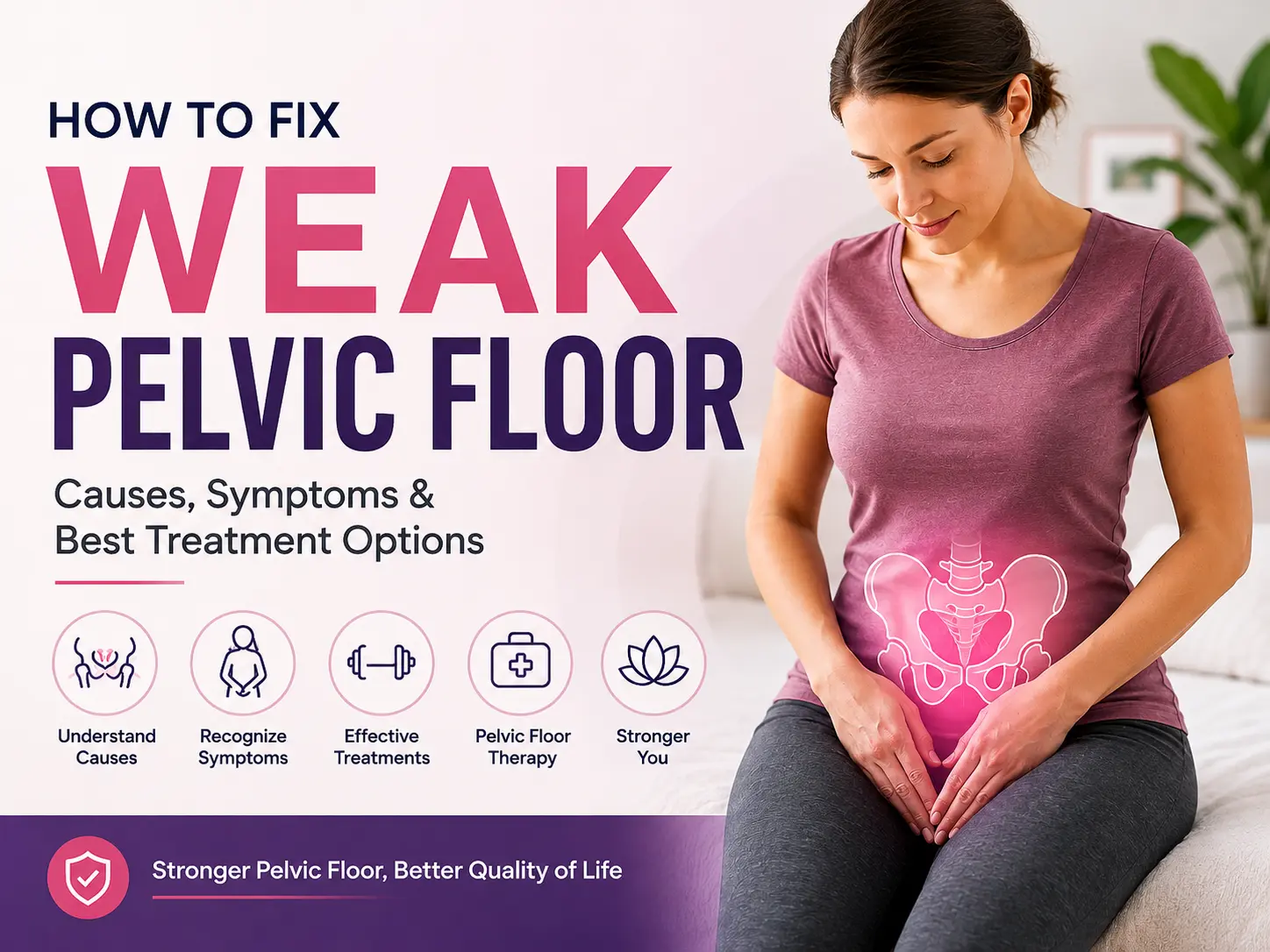
So what is the pelvic floor in women, exactly? It’s a hammock-like layer of muscle and connective tissue stretched across the base of the pelvis. It holds your pelvic organs in place, and it works constantly, even though you rarely think about it.
In women, this structure has to accommodate childbirth, hormonal shifts, and decades of everyday physical strain, which is part of why weakness here shows up more often in women than in men.
Where Is the Pelvic Floor Muscle?
If you’re not sure where is the pelvic floor muscle located, picture a sling running from your pubic bone at the front to your tailbone at the back, with additional support running side to side between your sit bones. It sits at the very bottom of your pelvic cavity, below your other core muscles, quietly holding everything up.
What Causes a Weak Pelvic Floor?
There’s rarely a single culprit. What cause weak pelvic floor issues, more often than not, is a combination of physical strain and natural changes that build up over years.
Pregnancy & Childbirth
Nine months of added weight and pressure takes a toll on the pelvic floor, and vaginal delivery can stretch or tear the muscles and connective tissue involved. Even women who deliver via cesarean section aren’t fully exempt, since the pregnancy itself still places significant strain on these muscles.
Aging
Like every muscle group in the body, the pelvic floor naturally loses mass and elasticity as you get older. This is a gradual process, but it’s a real one, and it’s part of why incontinence becomes more common with each passing decade. According to the National Institute of Diabetes and Digestive and Kidney Diseases (NIDDK), age-related muscle loss is one of the most consistently documented contributors to bladder control issues in older adults.
Menopause
Estrogen plays a role in keeping pelvic tissue firm and elastic. When levels drop during menopause, that tissue thins out, and the muscles supporting it often weaken alongside it.
Heavy Lifting
Repeatedly lifting heavy objects, whether at work, in the gym, or around the house, puts downward pressure on the pelvic floor. Without proper technique, that pressure can gradually wear down muscle support over time.
Obesity
Extra body weight means extra pressure sitting directly on top of the pelvic floor, every single day. Over time, that constant load can weaken the muscles faster than it would in someone carrying less weight.
How to Know If You Have a Weak Pelvic Floor
A lot of people live with mild symptoms for years without connecting the dots. So, how to know if you have a weak pelvic floor before it becomes a bigger problem?
Common Symptoms
Watch for leakage during exercise, coughing, or laughing. A frequent, sudden urge to urinate. A feeling of heaviness or pressure in the pelvic area. Trouble controlling gas. Lower back pain that doesn’t have an obvious cause. Any one of these on its own might not mean much, but a few together is worth paying attention to.
Some women also notice changes during sex, like reduced sensation or a feeling of looseness, which can be tied to the same underlying weakness. It’s an uncomfortable thing to bring up, understandably, but it’s a genuinely common symptom and one that pelvic floor therapy can often improve alongside the more commonly discussed issues.
When to See a Specialist
If symptoms are affecting your daily life, disrupting sleep, or getting worse rather than better, it’s time to talk to a doctor or a pelvic floor specialist. Waiting it out rarely helps, and early treatment tends to work faster than treatment started after years of avoidance. A good rule of thumb: if you’ve noticed the same symptom consistently for more than a few weeks, that’s long enough to bring it up rather than waiting to see if it resolves on its own.
How to Fix Weak Pelvic Floor Naturally
This is the part most people are really here for. How to fix weak pelvic floor issues without surgery or medication starts with a handful of proven, low-risk approaches.
Pelvic Floor Exercises
Do pelvic floor exercises work? Yes, and the research backing this is fairly strong. Consistent, correctly performed exercises are considered a first-line treatment for mild to moderate pelvic floor weakness, largely because they directly target the muscle group causing the problem rather than just managing symptoms around it.
The catch is that most people never receive proper instruction on how to do them. A quick search online turns up dozens of conflicting tips, and without feedback, it’s genuinely hard to know if you’re doing it right. That uncertainty is often what causes people to give up after a few weeks, assuming the exercises simply don’t work for them when really, they just weren’t engaging the correct muscles in the first place.
How Do You Strengthen Your Pelvic Floor?
How do you strengthen your pelvic floor in practice? It starts with correctly identifying the muscles, which many people get wrong on their first attempt, often engaging their glutes or thighs instead. From there, consistency matters more than intensity. A few minutes of focused contractions, several times a week, tends to outperform occasional longer sessions.
A simple way to start is holding a contraction for three to five seconds, then fully relaxing for the same amount of time, repeating this ten times in a row. As strength builds over several weeks, you can gradually extend the hold time. Progress here tends to be slow and steady rather than dramatic, which is normal and expected for this particular muscle group.
Pelvic Floor Therapy
For persistent or more severe cases, professional guidance helps considerably. What do they do in pelvic floor therapy that a home routine can’t replicate? A therapist assesses whether your muscles are weak, tight, or uncoordinated, then builds a plan specific to that finding, something that’s genuinely hard to figure out on your own. If you want a full breakdown of what a session actually involves, our guide on what happens in pelvic floor therapy covers it step by step.
Pelvic Floor Trainers
A pelvic floor trainer or pelvic floor exerciser can bridge the gap between unguided exercise and professional therapy. These devices use resistance, biofeedback, or gentle stimulation to confirm you’re engaging the right muscles, which removes a lot of the guesswork that trips people up when they’re doing Kegels blind.
For a lot of women, this is the missing piece that makes exercises actually stick. It’s one thing to be told which muscles to squeeze, and another thing entirely to get real-time confirmation that you’re doing it correctly. That feedback loop tends to shorten the learning curve considerably, sometimes cutting weeks off the time it takes to feel real progress.
Best Pelvic Floor Therapy Devices
If you’re ready to add a device to your routine, a few categories tend to come up most often, and the right one really depends on what you’re starting with.
A pelvic floor therapy device with biofeedback, like the TPFHealth Electronic Pelvic Toner, shows you in real time whether your contractions are actually engaging the right muscles. For anyone who struggles to consciously activate a weak pelvic floor, a pelvic floor stimulation device, sometimes called an electronic pelvic floor stimulator, uses mild electrical pulses to trigger the muscle directly, essentially jumpstarting activity that voluntary effort alone hasn’t managed to reach.
If your main goal is building endurance over weeks and months, a pelvic floor muscle stimulator paired with a graduated resistance tool, such as Kegel exercise balls, works well as a long-term strengthening device. Our complete guide to pelvic floor therapy devices compares these options side by side if you want help narrowing down which fits your specific situation.
Lifestyle Changes That Help Strengthen Your Pelvic Floor
Exercise and devices matter, but daily habits carry more weight than people usually expect. Small, consistent choices, repeated over months, often add up to more meaningful change than any single intervention on its own.
Weight Management
Since extra weight adds constant pressure to the pelvic floor, even a modest reduction can ease that load and improve symptoms. It’s rarely the whole solution on its own, but it makes every other treatment work a little better.
Walking
Is walking good for pelvic floor health? Generally, yes. It’s low impact, improves circulation, and supports overall muscle tone without placing excessive strain on the pelvic region, which makes it a safe starting point for almost anyone, including women in the early stages of postpartum recovery.
Pilates
Does pilates strengthen pelvic floor muscles? It can, since many pilates movements engage the deep core and pelvic floor together. That said, form matters a great deal here, and a few sessions with an instructor familiar with pelvic health is worth the investment before diving into a full class on your own. Certain pilates moves, particularly ones involving intense core bracing, can actually place unwanted pressure on a weak pelvic floor if the technique isn’t quite right, so starting slow and building awareness first tends to pay off.
Running
Does running strengthen pelvic floor muscles, or does it weaken them? The honest answer is that it depends. Running places repetitive impact on the pelvic floor, and for someone who’s already weak in this area, it can worsen symptoms rather than help them. Building baseline strength first, then gradually reintroducing running, tends to be the safer approach.
Here’s a quick side by side comparison of how these activities typically affect the pelvic floor:
| Activity | Effect on Pelvic Floor | Best For |
|---|---|---|
| Walking | Low impact, supportive | Almost everyone, including postpartum recovery |
| Pilates | Strengthening when done correctly | Building core and pelvic coordination |
| Running | Can strengthen or worsen symptoms | Those with an already strong pelvic floor base |
Common Mistakes That Can Make a Weak Pelvic Floor Worse
Ignoring Symptoms
Mild leakage or occasional pressure often gets dismissed as normal, especially after childbirth or with age. Left unaddressed, symptoms tend to gradually worsen rather than resolve on their own. What starts as an occasional leak during a hard sneeze can, over months or years, progress into something that affects daily choices, like avoiding certain exercises or planning outings around bathroom access.
Incorrect Kegel Exercises
Engaging the wrong muscles, holding your breath, or over-tightening the glutes and thighs instead of the pelvic floor is a common mistake that can make exercises ineffective, or in some cases, counterproductive. This is exactly the kind of issue a biofeedback device or a session with a pelvic floor therapist can catch quickly, often within a single session, that might otherwise take months to figure out through trial and error.
Lifting Heavy Objects
Lifting without proper core engagement or breathing technique places sudden, excessive pressure on the pelvic floor. Learning to exhale during the lift, rather than holding your breath, makes a real difference here.
Delaying Treatment
The longer weakness goes untreated, the more it tends to affect daily confidence and comfort. Early intervention, even something as simple as starting a consistent exercise routine, usually produces better results than waiting until symptoms become severe.
Frequently Asked Questions (FAQ)
Quick reference answers for pelvic floor strengthening, symptoms, therapy, and device options:
How to fix weak pelvic floor?
A combination of correctly performed pelvic floor exercises, lifestyle adjustments, and, when needed, professional therapy or a guided trainer device tends to produce the best results.
How do you strengthen your pelvic floor?
Consistent, correctly targeted exercises, ideally confirmed through biofeedback or professional guidance, are the most reliable way to build lasting strength.
Do pelvic floor exercises work?
Yes. When performed correctly and consistently, they’re one of the most effective, well-researched treatments for pelvic floor weakness.
How to know if you have a weak pelvic floor?
Signs include leakage during exercise or laughing, urgency, a feeling of pelvic heaviness, and difficulty controlling gas. Several of these together are worth mentioning to a doctor.
What causes weak pelvic floor?
Pregnancy, childbirth, aging, menopause, heavy lifting, and obesity are among the most common contributing factors.
What do they do in pelvic floor therapy?
Therapy typically involves an assessment, physical examination, muscle testing, and a treatment plan combining manual therapy, guided exercises, and sometimes biofeedback or electrical stimulation.
What is a pelvic floor trainer?
It’s a device designed to strengthen or retrain the pelvic floor muscles through resistance, biofeedback, or electrical stimulation, often used alongside or in place of unguided exercise.
Is walking good for pelvic floor?
Yes, walking is generally considered a safe, low-impact activity that supports pelvic floor health without the strain that higher-impact exercise can sometimes cause.
Final Thoughts & Next Steps
A weak pelvic floor is common, and more importantly, it’s treatable. Whether the cause is childbirth, aging, menopause, or years of heavy lifting, the path forward usually starts with the same basics: correctly performed exercises, healthier daily habits, and patience with a process that takes weeks rather than days.
For extra support along the way, a pelvic floor trainer, pelvic floor therapy device, or pelvic floor exerciser can help confirm you’re doing the work correctly and speed up progress between sessions. If you’re ready to get started, you can explore our full range of pelvic floor devices here, or reach out to our team if you’d like guidance on which option fits your needs. And if symptoms are affecting your day to day life, don’t wait, a conversation with a healthcare professional is always a good next step.
