
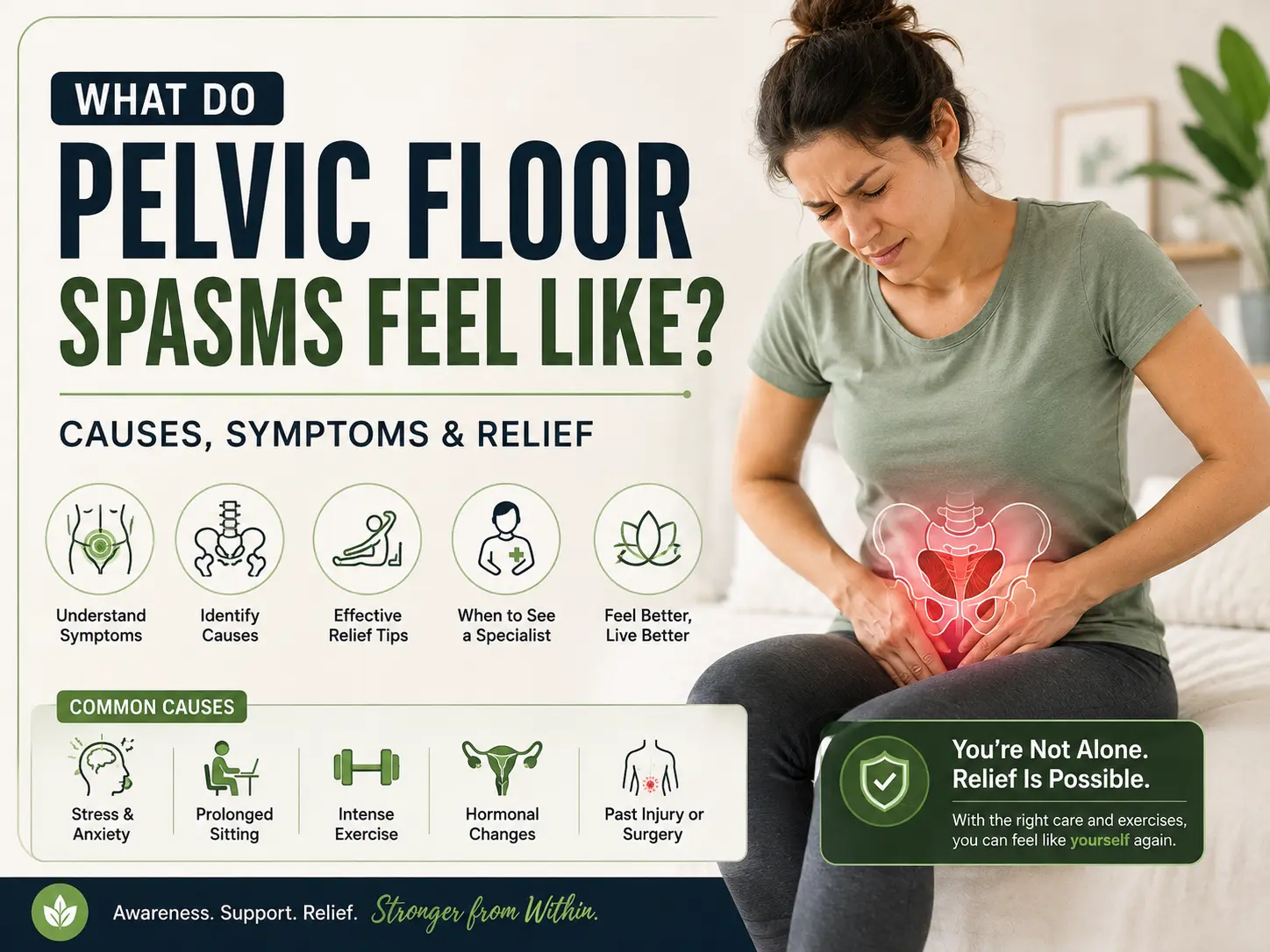
It usually catches people off guard the first time. A sudden cramping sensation deep in the pelvis, sometimes sharp, sometimes more of a dull, gripping ache, that seems to come out of nowhere. There’s no obvious injury to point to, no fall or strain that explains it, which makes the whole thing feel a bit unsettling. A quick search later, and most people land on the same term: pelvic floor spasms.
If you’re here because you’ve felt something like this yourself, you’re in the right place. This guide breaks down what pelvic floor spasms actually feel like, why they happen, and what genuinely helps, whether that’s a few stretches you can try tonight or a conversation worth having with a specialist. At TherapyPelvicFloor, this is exactly the kind of question we hear often, and it deserves a clear, honest answer rather than vague reassurance.
What Do Pelvic Floor Spasms Feel Like?
Most people describe pelvic floor spasms as a sudden tightening or cramping sensation somewhere deep in the pelvic region, often hard to pinpoint exactly. It’s not quite like a muscle cramp in your calf, which you can usually locate and rub out. This feels more internal, sometimes radiating toward the lower back, inner thighs, or tailbone.
Some describe it as a charley horse that happens internally rather than in a limb. Others say it feels like a persistent, uncomfortable pulling sensation, as if something is being squeezed too tightly and won’t let go. The intensity varies quite a bit too. For some, it’s a mild, occasional nuisance. For others, it’s sharp enough to stop them mid-activity, whether that’s during exercise, sex, or even just sitting for too long in one position.
What makes pelvic floor spasms particularly frustrating is the unpredictability. They can show up during stress, after sitting for hours, following intense exercise, or seemingly for no reason at all, which is part of why so many people end up searching for answers rather than just waiting for it to pass.
Some people also notice spasms cluster around certain times, right before a menstrual period, during ovulation, or after a particularly stressful stretch at work. That pattern isn’t a coincidence. Hormonal shifts and stress both influence how much baseline tension the pelvic floor is carrying, which means a muscle that’s already close to its limit needs less to tip over into an actual spasm.
What Causes Pelvic Floor Spasms?
There’s rarely one single trigger. Spasms tend to develop from a mix of physical and even emotional factors that build up over time.
What causes a tight pelvic floor in the first place often comes down to the muscle group being overworked or chronically guarded, similar to how your shoulders might tense up during a stressful week without you fully noticing it happening. Past injury, surgery, childbirth complications, or even years of poor posture can all contribute to this kind of ongoing tension.
Pelvic floor muscle tension frequently develops as a protective response. If the body associates a certain movement or sensation with pain, whether from an old injury or a medical condition like endometriosis, the pelvic floor muscles can start clenching automatically as a kind of defense mechanism, even when there’s no active threat anymore.
Stress and muscle tension are also more connected than most people realize. The pelvic floor, much like the jaw or shoulders, is a common place for the body to store tension during periods of anxiety or chronic stress. Over time, that pattern of unconscious clenching can turn into recurring spasms, especially in people who already carry stress physically rather than just mentally.
Sitting for long stretches, particularly in an office chair with poor posture, adds another layer to this. Prolonged sitting compresses the pelvic region and can encourage the muscles to stay in a shortened, tense position for hours at a time, which over months can become the muscle’s new default rather than something it consciously chooses to do.
Common Symptoms of Pelvic Floor Spasms
Spasms rarely show up in isolation. They usually bring a handful of related symptoms along with them.
Pelvic pain is the most obvious one, ranging from a dull ache to sharp, sudden discomfort that can appear during activity or at rest, without much warning either way.
Muscle tightness often accompanies the pain, sometimes described as a persistent gripping sensation that doesn’t fully ease up even after the sharper spasm passes.
Pressure in the pelvic region is another common complaint, sometimes mistaken for bladder fullness or even digestive discomfort, which is part of why pelvic floor issues get misdiagnosed fairly often.
Discomfort during urination or bowel movements can also occur, since a tense pelvic floor makes it harder for these muscles to fully relax when they need to, leading to straining, incomplete emptying, or a burning sensation that has nothing to do with infection.
It’s worth noting how these symptoms differ from what someone with a weak pelvic floor typically experiences, since the two are sometimes confused with each other even though the underlying issue and treatment are almost opposite.
| Tight or Spasming Pelvic Floor | Weak Pelvic Floor | |
|---|---|---|
| Main sensation | Cramping, pressure, pain | Leakage, heaviness |
| Common trigger | Stress, prolonged sitting, past injury | Childbirth, aging, menopause |
| Treatment focus | Relaxation, stretching, manual release | Strengthening exercises, resistance training |
What Does a Tight Pelvic Floor Feel Like?
This is a slightly different question than the spasm itself, though the two are closely related. A tight pelvic floor tends to feel like constant, low-grade tension rather than the sudden, sharp episodes associated with an active spasm. Some people describe it as a persistent feeling of fullness or pressure, almost like sitting on a small, hard object that isn’t actually there.
Others notice it mostly during specific activities, like intercourse, insertion of a tampon, or even during a pelvic exam, where the muscles seem to resist relaxing no matter how much conscious effort goes into it. This chronic tightness is often the underlying condition that eventually produces the more noticeable spasm episodes, which is why addressing the baseline tension matters just as much as managing individual flare-ups.
It can also feel oddly similar to holding in a sneeze for too long, that specific kind of muscular bracing that doesn’t quite let go even after the moment has passed. Over time, if that bracing becomes the muscle’s resting state rather than an occasional response, it stops feeling unusual to the person experiencing it, which is part of why chronic tightness often goes unaddressed for years before someone finally mentions it to a doctor.
How to Relax Pelvic Floor Muscles
The encouraging part of all this is that pelvic floor spasms, in most cases, respond well to the right combination of relaxation techniques and, when needed, professional guidance.
How to Relax a Tight Pelvic Floor
Learning how to relax a tight pelvic floor starts with awareness, which sounds simple but is actually the hardest part for a lot of people. Because these muscles are internal and rarely consciously controlled, many people don’t even realize they’re clenched until a therapist points it out during an assessment.
Diaphragmatic breathing is one of the most effective starting points. Deep, slow belly breaths naturally encourage the pelvic floor to release along with the diaphragm, since the two work together during normal breathing. Practicing this for five to ten minutes a day, lying down in a quiet space, can meaningfully reduce baseline tension over a few weeks.
A useful way to practice this is placing one hand on your chest and one on your stomach, breathing in slowly through your nose so the stomach hand rises while the chest hand stays relatively still. Exhale slowly through pursed lips, and try to consciously notice the pelvic floor softening as you breathe out. It sounds small, but this kind of body awareness training is often the missing link for people who’ve tried other relaxation methods without much success.
How to Relax Pelvic Floor Muscles Female
For spasms that don’t improve with home techniques, professional pelvic floor therapy tends to offer the most reliable relief. A therapist trained in this area can use manual release techniques, guided relaxation exercises, and biofeedback to identify exactly where tension is concentrated and address it directly, something that’s genuinely difficult to do through self-treatment alone.
Gentle Pelvic Floor Stretching
Gentle stretching, including child’s pose, deep squats, and happy baby pose, can help lengthen and release tension in the pelvic floor and surrounding hip muscles. These stretches work best when held for thirty seconds to a minute, paired with slow breathing throughout, rather than rushed through as a quick warmup.
How Pelvic Floor Therapy Can Help With Spasms
For spasms that don’t improve with home techniques, professional pelvic floor therapy tends to offer the most reliable relief. A therapist trained in this area can use manual release techniques, guided relaxation exercises, and biofeedback to identify exactly where tension is concentrated and address it directly, something that’s genuinely difficult to do through self-treatment alone.
This is a different approach than what most people picture from strengthening based therapy. Instead of building muscle, the goal here is teaching the muscle to fully release, which requires its own specific set of techniques. If you’re curious about what a typical session actually looks like, our detailed guide on what happens during pelvic floor therapy walks through the full process, including how therapists distinguish between weakness and tightness during assessment.
According to Johns Hopkins Medicine, pelvic floor dysfunction, including chronic tightness and spasm, is a genuine and treatable medical condition, not something that should be dismissed as minor discomfort or simply pushed through.
Pelvic Floor Exercises for a Tight Pelvic Floor
This is an area where a lot of people accidentally make things worse before they get better. If your pelvic floor is already tight, traditional strengthening exercises, like standard Kegels, can actually increase tension rather than relieve it, since you’d be adding more contraction work onto muscles that are already struggling to relax.
Instead, exercises for a tight pelvic floor should focus on release and coordination rather than pure strength. This might include controlled relaxation drills, where you practice a gentle contraction followed by a deliberately long, slow release, training the muscle to let go fully rather than staying in a partially clenched state.
A pelvic floor trainer with biofeedback can genuinely help here too, not just for strengthening, which is how most people assume these devices are used, but for confirming that you’re actually achieving a full release between contractions rather than only partially relaxing. Devices like the TPFHealth Electronic Pelvic Toner can support this kind of guided practice at home, giving you real time feedback on whether your muscles are truly letting go.
It’s worth being honest here. Working with a pelvic floor therapist first, even briefly, tends to produce far better results than guessing at this on your own, simply because tightness related exercises are easy to get subtly wrong in a way that reinforces the very pattern you’re trying to fix.
Foam rolling the inner thighs and hips, along with gentle hip opener stretches like butterfly pose, can also support pelvic floor release indirectly, since these muscles don’t work in isolation. Tension in the surrounding hip and thigh muscles often pulls on the pelvic floor as well, so loosening that broader area sometimes takes pressure off the pelvic floor itself even without directly touching it.
When Should You See a Pelvic Floor Specialist?
A few signs suggest it’s time to move beyond home remedies and get a professional opinion. If spasms are frequent, increasingly painful, or interfering with daily activities like sitting, exercising, or intimacy, that’s a reasonable point to book an appointment. Pain during urination or bowel movements that doesn’t resolve, or that’s accompanied by other symptoms like fever or unusual discharge, also warrants medical evaluation rather than continued self management.
It’s also worth seeing a specialist if you’ve tried relaxation techniques consistently for several weeks without any noticeable improvement. Chronic tightness sometimes has an underlying cause, like scar tissue from a past surgery or an undiagnosed condition such as endometriosis, that needs to be identified before treatment can really move forward. TherapyPelvicFloor always recommends treating persistent symptoms as worth a real conversation with a healthcare provider rather than something to quietly manage indefinitely on your own.
There’s also no need to wait until symptoms feel severe before reaching out. Many pelvic floor specialists would rather see someone early, when tightness is mild and easier to address, than months later once the pattern has become deeply ingrained. Think of it less like an emergency room visit and more like the kind of appointment you’d book for a nagging shoulder issue before it turns into something that limits your range of motion entirely.
Frequently Asked Questions
What do pelvic floor spasms feel like?
Most people describe them as a sudden cramping or tightening sensation deep in the pelvis, sometimes radiating to the lower back or inner thighs, ranging from a mild ache to sharp, activity stopping pain.
What causes a tight pelvic floor?
Common causes include chronic stress, past injury or surgery, childbirth complications, poor posture, and the muscles developing a protective clenching pattern in response to pain or anxiety.
What does a tight pelvic floor feel like?
It often feels like persistent, low-grade pressure or fullness in the pelvic area, sometimes worsening during specific activities like intercourse or sitting for extended periods.
How do you relax a tight pelvic floor?
Diaphragmatic breathing, gentle stretching, reverse Kegel techniques, and, for more persistent cases, guided pelvic floor therapy are the most effective approaches.
How do you relax pelvic floor muscles?
Focus on slow, deep breathing that allows the pelvic floor to release naturally, paired with gentle stretches and, if needed, professional biofeedback guided sessions to confirm you’re achieving a full release.
Final Thoughts
Pelvic floor spasms are uncomfortable, sometimes alarming, but genuinely manageable once you understand what’s actually happening in the body. Whether the root cause is stress, an old injury, or muscles that have simply learned to stay guarded, relief usually comes from teaching that muscle group how to let go again, not from pushing harder or ignoring it and hoping it resolves.
Start with the basics, breathing, gentle stretching, and paying closer attention to how your body holds tension throughout the day. If symptoms persist, a pelvic floor therapist can offer a level of targeted care that’s hard to replicate on your own. At TherapyPelvicFloor, we offer tools like the TPFHealth Electronic Pelvic Toner to support that process at home, and you’re always welcome to reach out to our team if you’d like guidance on what might work best for your situation. And if the pain is persistent or getting worse, please don’t wait on speaking with a healthcare professional.
