
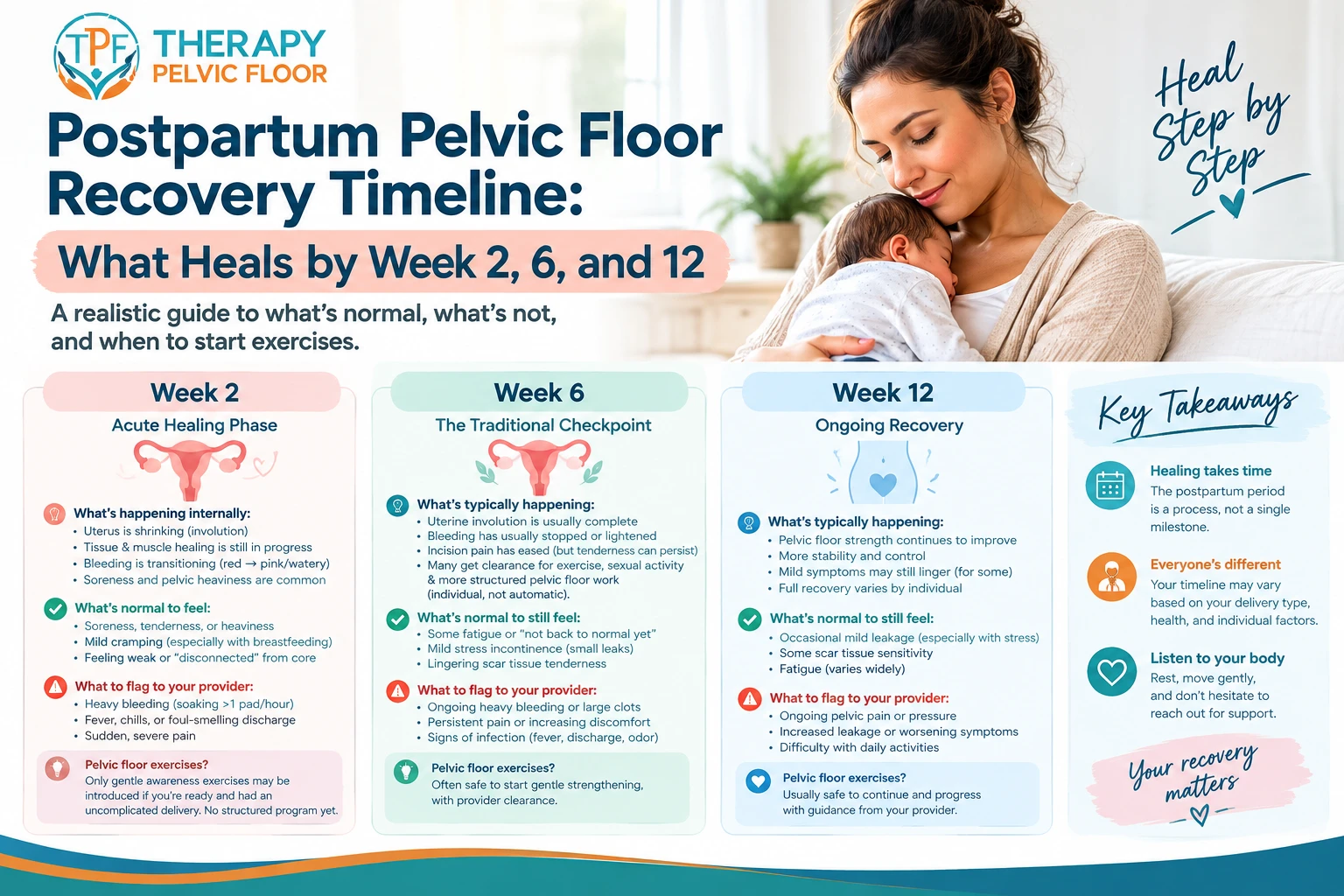
If you’ve searched for a postpartum recovery timeline, you’ve probably run into two extremes: vague reassurance (“every body is different!”) or intimidating detail that doesn’t tell you what actually matters for your pelvic floor specifically.
This guide fills that gap. It walks through what’s genuinely happening to your pelvic floor at three key checkpoints — week 2, week 6, and week 12 — based on how obstetric and pelvic health guidance describes the recovery process, plus what’s normal to feel, what’s worth flagging to a provider, and when it’s reasonable to start rebuilding strength.
One framing worth keeping in mind throughout: the American College of Obstetricians and Gynecologists (ACOG) refers to the entire 12-week period after birth as the “fourth trimester” precisely because recovery is an ongoing process, not something that resolves at a single milestone visit. If you feel like you’re not “done” healing by any of these checkpoints, that’s expected, not a red flag on its own.
Week 2 Postpartum: Acute Healing Phase
At two weeks, you’re still in the more intense stretch of physical recovery, whether you delivered vaginally or by cesarean.
What’s happening internally:
- Your uterus is in the process of shrinking back down from its pregnancy size through a process called involution, which continues over several weeks.
- If you had a vaginal delivery with tearing or an episiotomy, the external tissue has often started to close, but deeper muscle-layer healing is still ongoing.
- If you had a cesarean, the skin incision may look mostly healed, while the underlying muscle layers are still repairing — full internal healing for a C-section incision commonly takes longer than the visible scar suggests.
- Vaginal bleeding (lochia) is typically transitioning from red to a pinker or more watery texture around this point.
What’s normal to feel:
- Soreness, tenderness, or a heavy sensation in the pelvic area, especially with standing or activity
- Ongoing mild cramping, particularly during breastfeeding or pumping (this is your uterus contracting)
- Feeling weak or "disconnected" from your core and pelvic floor — this is common and doesn’t necessarily mean permanent damage
What to flag to your provider at this stage:
- Heavy bleeding that soaks more than one pad an hour, or passing large clots
- Fever, chills, or a foul-smelling discharge
- Sudden, severe pain that doesn’t match your expected healing pattern
Should you be exercising your pelvic floor at week 2? Very gentle awareness exercises — like a light, brief contraction and release, done a few times a day — are sometimes introduced early if you had an uncomplicated delivery and feel ready, but this varies significantly by individual and delivery type. This is not the time for a structured strengthening program or device-based training. If in doubt, wait for your provider’s guidance rather than guessing.
Week 6 Postpartum: The Traditional Checkpoint
Six weeks has long been treated as "the" postpartum milestone — historically, it’s when a single comprehensive checkup was scheduled. ACOG’s more recent guidance actually recommends contact with a maternal care provider within the first 3 weeks, with a comprehensive visit following no later than 12 weeks — meaning 6 weeks is a common check-in point, but not necessarily your final assessment.
What’s typically happening by week 6:
- Uterine involution is usually complete or nearly complete, with the uterus close to its pre-pregnancy size.
- Vaginal bleeding has usually stopped or significantly lightened for most people by this point.
- Perineal or C-section incision pain has often eased substantially, though tenderness around the scar tissue itself can persist longer.
- This is the point where many providers give clearance for resuming exercise, sexual activity, and more structured pelvic floor work — but that clearance is individual, not automatic.
What’s normal to still feel:
- Some fatigue or general "not back to normal yet" sensation — this is expected and doesn’t mean something’s wrong
- Mild stress incontinence (small leaks with coughing, sneezing, or laughing), especially if you haven’t yet started structured pelvic floor exercises
- Lingering scar tissue tenderness (perineal or C-section)
What to flag to your provider at this stage:
- Ongoing or worsening leaking, rather than gradual improvement
- A visible or felt bulge in the vaginal area (a possible sign of prolapse)
- Pain during attempted intercourse that doesn’t ease with time
- Persistent gaps or doming along the abdominal midline (a sign of diastasis recti that hasn’t started closing)
Is week 6 when you can start a pelvic floor exercise routine? For many people who receive normal clearance at this checkpoint, yes — this is often when providers give the go-ahead to begin structured Kegels or a guided pelvic floor program. If you’re considering a device like a biofeedback probe or an electronic pelvic toner, this is generally the earliest point worth discussing it with your provider — not before you’ve had that clearance conversation.
Week 12 Postpartum: End of the "Fourth Trimester"
Twelve weeks marks the formal end of what’s commonly called the fourth trimester — but it’s worth being clear that this is a milestone for ongoing care, not a finish line for healing.
What’s typically happening by week 12:
- Deeper muscle and connective tissue healing (including C-section muscle layers) is generally much further along, though full tissue remodeling can continue for months.
- Hormone levels are stabilizing further, particularly if you’re not breastfeeding (breastfeeding can extend certain hormonal effects, including vaginal tissue changes).
- Pelvic floor strength, if you’ve been doing structured exercises since your clearance, often starts showing more noticeable improvement around this point.
What’s normal to still feel:
- Continued gradual improvement in strength and control rather than a sudden "fixed" feeling
- Some people still experience mild symptoms (leaking, heaviness) that are actively improving with consistent exercise
- Diastasis recti gap continuing to narrow, if you’ve been doing appropriate core-safe exercises
What’s worth a specialist referral at this stage:
- Persistent or worsening incontinence despite 6+ weeks of consistent pelvic floor exercise
- A diastasis recti gap that hasn’t narrowed at all
- Ongoing pelvic pain, pressure, or a sense of prolapse
- Any symptom that’s affecting your daily function or mental wellbeing
If symptoms are persisting at 12 weeks despite consistent effort, this is generally the point where a referral to a pelvic floor physical therapist — someone trained specifically in this area, distinct from general postpartum guidance — becomes genuinely worth pursuing rather than continuing to "wait and see."
A Realistic Summary Timeline
| Checkpoint | What’s typically happening | Reasonable expectation |
|---|---|---|
| Week 2 | Acute healing, uterus still shrinking | Rest and gentle awareness only |
| Week 6 | Traditional clearance checkpoint | Often cleared to begin structured exercise |
| Week 12 | End of "fourth trimester" | Gradual improvement, not full resolution |
| Beyond 12 weeks | Ongoing tissue remodeling continues | Full recovery can take 6–12 months total |
Frequently Asked Questions
Is it normal to still have symptoms after 12 weeks postpartum?
Yes. Many sources describing postpartum recovery note that full physical recovery can take significantly longer than 12 weeks — the fourth trimester marks a care milestone, not a guaranteed healing endpoint. Continued improvement with consistent pelvic floor exercise is common well beyond this point.
When can I safely start Kegel exercises after birth?
This depends entirely on your individual delivery and healing, so the honest answer is: whenever your provider clears you, typically discussed at your postpartum checkup. Gentle awareness work may start earlier for some people, but structured strengthening routines are usually best started after a clearance conversation.
How do I know if my pelvic floor symptoms need a specialist instead of just more time?
If symptoms are persisting or worsening despite consistent, correctly performed exercise over several weeks — or if you notice a visible bulge, ongoing pain, or a diastasis recti gap that isn’t narrowing — these are reasonable signs to seek a pelvic floor physical therapist rather than continuing to wait.
Does a C-section mean my pelvic floor doesn't need recovery attention?
No. While a C-section avoids the direct trauma of vaginal delivery, the pelvic floor still carries the weight of pregnancy for nine months and can still be affected by hormonal changes, reduced activity during recovery, and the physical demands of pregnancy itself. Many C-section patients still benefit from pelvic floor rehabilitation.
What's the difference between "cleared for exercise" and "cleared for pelvic floor training specifically"?
General exercise clearance (often given around 6 weeks) usually covers light cardio and general movement. Pelvic floor–specific training, especially anything involving internal devices, is worth confirming separately with your provider, since the two aren’t always cleared at exactly the same point for every person.
