
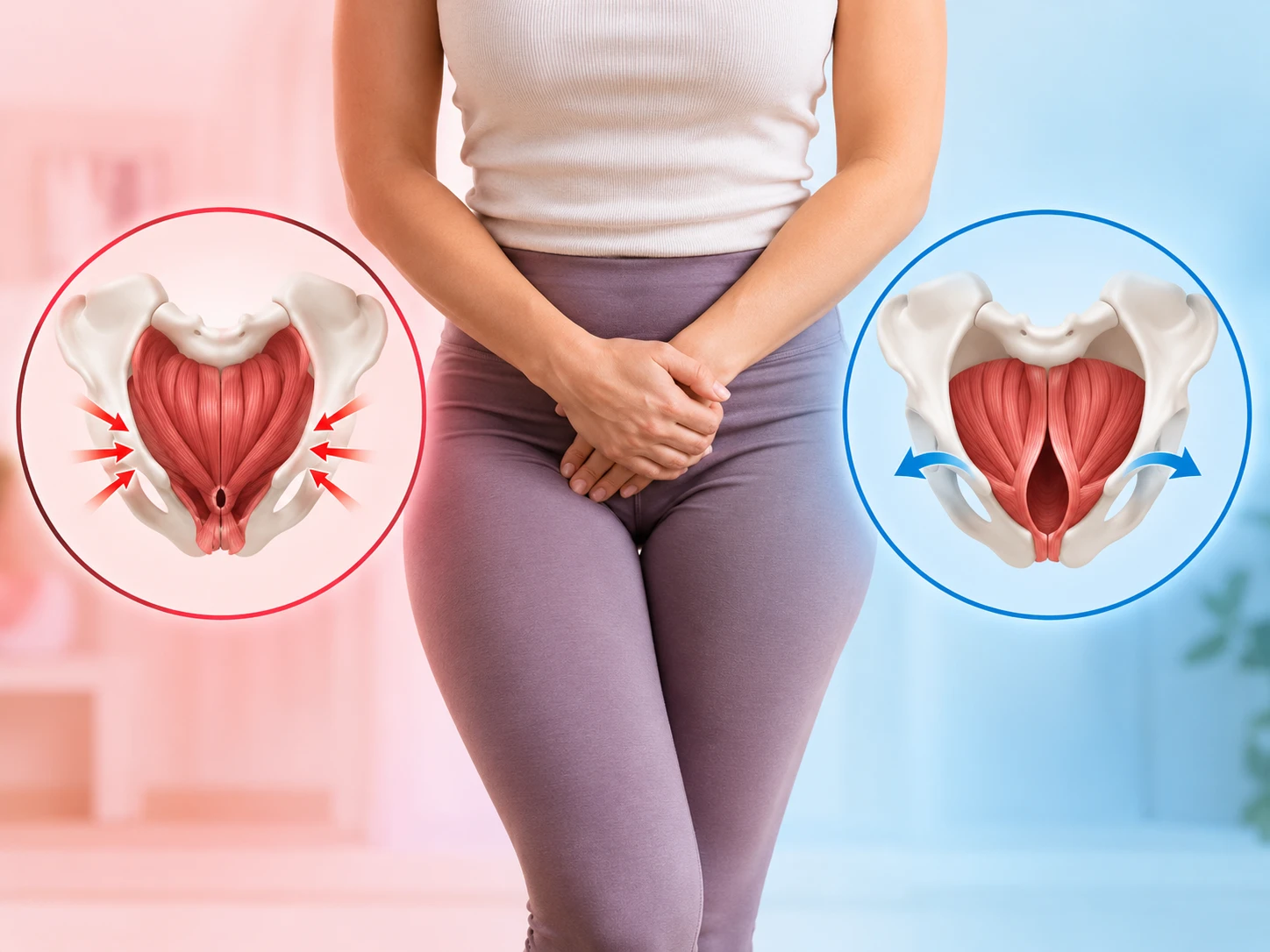
Most advice about pelvic floor problems starts from one assumption: that your pelvic floor is weak, and the fix is to strengthen it. But for a meaningful number of people, the actual problem is the opposite a pelvic floor that’s too tight, not too loose. And here’s the part that trips people up: a tight pelvic floor can cause many of the same symptoms as a weak one, including leaking and urgency, which is exactly why so many people spend months doing Kegels for a problem Kegels can’t fix and sometimes make worse.
This guide breaks down what a tight (hypertonic) pelvic floor actually feels like, how it’s different from weakness, and what actually helps.
What Does "Tight Pelvic Floor" Actually Mean?
A tight, or hypertonic, pelvic floor means the muscles are chronically contracted or hold excess tension even at rest, when they should be relaxed. This is functionally different from a weak pelvic floor, where the muscles struggle to contract with enough strength when you need them to.
Think of it like a fist clenched all day versus a hand too weak to make a fist at all. Both cause problems, but they need opposite solutions.
Common Tight Pelvic Floor Symptoms
Pelvic Pain or Pressure
A persistent feeling of pressure, aching, or discomfort in the pelvic region sometimes described as a dull ache, sometimes sharper, that isn’t tied to your menstrual cycle or another obvious cause.
Pain During Intercourse
Difficulty with penetration, or pain during or after sex, is one of the more common and often under-discussed symptoms of a tight pelvic floor. Muscles that can’t relax on cue make penetration genuinely more difficult and uncomfortable.
Difficulty Starting or Fully Emptying Your Bladder
A tight pelvic floor can make it harder to fully relax during urination, sometimes leading to a slow stream, a sense of incomplete emptying, or needing to strain more than usual.
Constipation or Straining With Bowel Movements
Similarly, if the muscles involved in the bowel-movement process can’t relax properly, this can cause chronic constipation or a sense of straining that doesn’t match your diet or hydration habits.
Lower Back or Hip Pain
Because the pelvic floor works closely with surrounding core and hip muscles, chronic tension here can radiate outward, showing up as lower back pain or hip discomfort that doesn’t resolve with typical stretching.
Urinary Urgency or Frequency Without Actual Leaking
This is the symptom that confuses people most, because it sounds like a weakness problem. A tight pelvic floor can irritate the bladder and create a frequent, urgent need to urinate, even when there’s no actual incontinence happening.
A Feeling of "Clenching" You Can't Consciously Release
Some people describe a sense that something in the pelvic area is gripping or clenched, especially during stress, and that they can’t consciously will it to relax unlike a muscle you can simply choose to loosen.
Tight vs. Weak: A Side-by-Side Comparison
| Symptom | More likely Tight (Hypertonic) | More likely Weak |
|---|---|---|
| Leaking with cough/sneeze/exercise | Less typical | Classic sign |
| Pain during intercourse | Common | Uncommon |
| Difficulty fully emptying bladder | Common | Uncommon |
| Pelvic pain or pressure | Common | Less typical |
| Leaking with urgency, no pain | Possible | Common |
| Feeling of heaviness/bulge | Can occur in both — flag to a provider either way | Can occur in both — flag to a provider either way |
This table is a general guide, not a diagnosis many people have a mix of both tightness and weakness in different areas of the pelvic floor simultaneously, which is part of why self-diagnosing from symptoms alone has real limits.
Why Doing More Kegels Can Make a Tight Pelvic Floor Worse
This is the most important thing to understand if you suspect tightness rather than weakness: a Kegel is a contraction exercise. If your pelvic floor is already over-contracted, adding more contraction work doesn’t address the actual problem it can increase tension and, in some cases, worsen symptoms like pain or urgency.
This is a big part of why generic “just do your Kegels” advice doesn’t work for everyone, and why it’s worth figuring out which category you’re actually in before starting a training routine.
What Actually Helps a Tight Pelvic Floor
- Relaxation-focused breathing and stretching. Techniques that emphasize lengthening and releasing the pelvic floor rather than contracting it are generally the starting point for tightness-related symptoms, often including diaphragmatic breathing and specific hip-opening stretches.
- Reverse Kegels. Rather than squeezing, a reverse Kegel focuses on consciously lengthening and releasing the pelvic floor muscles, essentially the opposite motion of a standard Kegel.
- Biofeedback, used differently. A biofeedback device isn’t only useful for confirming a strong contraction it can also help you learn what a full release feels like, which is often the harder skill to learn consciously for a chronically tense pelvic floor. If you’re using a biofeedback probe at home, the goal in this case is confirming relaxation, not maximizing contraction strength.
- Pelvic floor physical therapy. This is genuinely the gold-standard approach for a suspected tight pelvic floor, since a specialist can assess internally, confirm whether tightness is actually the issue, and guide you through manual release techniques that are difficult to self-administer accurately.
What Doesn't Help and May Make Things Worse
- Generic Kegel programs aimed at strengthening, without addressing the underlying tension first
- High-intensity EMS stimulation devices used without first confirming whether tightness is the actual issue stimulation triggers contraction, which is the opposite of what a hypertonic pelvic floor typically needs
- Pushing through pain during intercourse or exercise, rather than addressing the tension directly
When to See a Pelvic Floor Physical Therapist
It’s worth seeing a pelvic floor physical therapist if:
- Pain during intercourse that persists beyond a few occurrences
- Chronic pelvic pain or pressure without a clear cause
- Difficulty fully emptying your bladder or bowels regularly
- Symptoms that haven’t improved or have worsened after trying a standard Kegel routine
- Any symptom significantly affecting your daily life or wellbeing
A pelvic floor physical therapist can perform an internal assessment to determine whether tightness, weakness, or a combination of both is driving your symptoms something that’s genuinely difficult to determine from the outside on your own.
Frequently Asked Questions
Can I have both a tight and weak pelvic floor at the same time?
Yes. It’s possible for different parts of the pelvic floor to be tight while others are weak, or for a chronically tight pelvic floor to also struggle with generating strong, coordinated contractions when needed. This is one of the main reasons a professional assessment is more reliable than self-diagnosis.
Will Kegels help a tight pelvic floor at all?
Generally, standard strengthening-focused Kegels aren’t the first recommended approach for a tight pelvic floor, and may worsen symptoms in some cases. Relaxation-focused techniques, like reverse Kegels and targeted stretching, are typically the better starting point.
What's a reverse Kegel?
A reverse Kegel is the intentional lengthening and releasing of the pelvic floor muscles essentially bearing down gently rather than squeezing and is commonly used as part of pelvic floor relaxation training for tightness-related symptoms.
How do I know if my urinary urgency is from tightness or weakness?
Urgency without actual leaking is more commonly associated with a tight, irritated pelvic floor, while leaking during physical exertion (coughing, sneezing, exercise) is more commonly associated with weakness. That said, these patterns aren’t absolute, and a proper assessment is the most reliable way to know for sure.
Can stress cause a tight pelvic floor?
Yes. Like other muscle groups (think clenched jaw or raised shoulders), the pelvic floor can hold chronic tension in response to stress or anxiety, without you consciously noticing it’s happening.
Is pelvic floor tightness more common after childbirth, or is it unrelated to pregnancy?
It can occur with or without pregnancy. While much postpartum pelvic floor content focuses on weakness, pelvic floor tightness can also develop postpartum particularly around scar tissue from tearing or an episiotomy or can be entirely unrelated to childbirth.
