
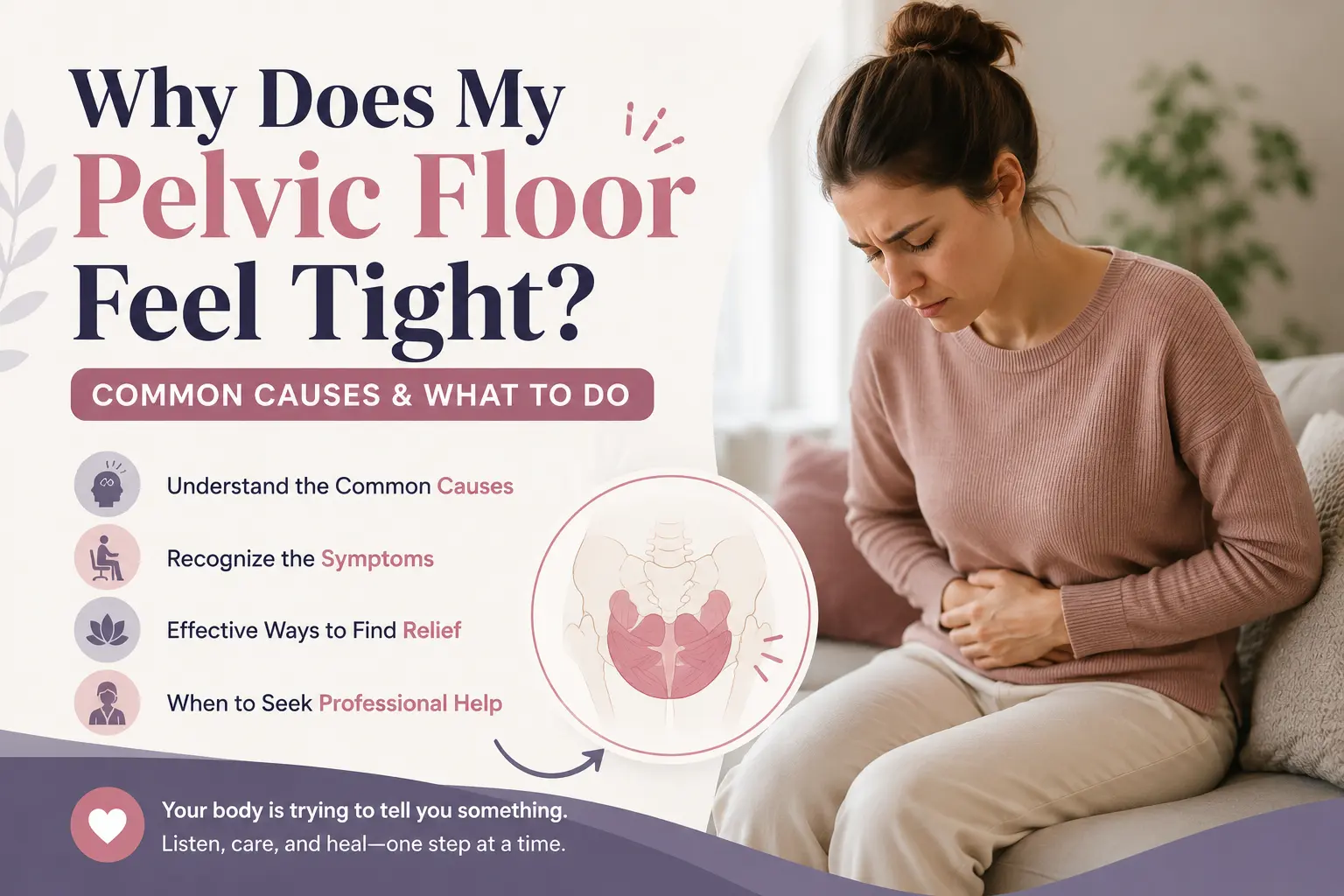
You’ve probably typed some version of this into a search bar late at night, half worried and half hoping for a simple answer. Why does my pelvic floor feel tight. Maybe it’s a dull, persistent pressure that never fully goes away. Maybe it shows up mostly when you sit for too long, or during intimacy, or for no reason you can point to at all.
A tight pelvic floor means the muscles supporting your bladder, bowel, and pelvic organs are holding more tension than they should, often without you consciously choosing to clench them. This isn’t the same as weakness, which tends to get far more attention in general conversation. Tension is its own issue, with its own set of causes and its own approach to fixing it.
Left unaddressed, this kind of tightness can lead to genuine discomfort, disrupted sleep, and in some cases, urinary or bowel symptoms that seem unrelated at first glance. If it’s persistent or getting worse, it’s worth professional attention rather than something to just push through. At TherapyPelvicFloor, this is one of the questions we hear most often, and it deserves a real, thorough answer.
Here’s the reassuring part before we get into the details. A tight pelvic floor is common, it’s well understood by specialists in this field, and it responds well to the right combination of home techniques and, when needed, professional care. You’re not dealing with something rare or mysterious, even if it feels that way right now.
Why Does My Pelvic Floor Feel Tight?
There’s rarely a single reason. Tightness usually builds gradually, from a combination of physical habits and emotional stress that accumulate over weeks or months without much notice.
Overactive pelvic floor muscles are often at the center of it. Some people simply have a pelvic floor that stays partially contracted more than it should, similar to how someone might unconsciously clench their jaw throughout a stressful day without realizing it until it starts to ache.
Stress and anxiety play a bigger role here than most people expect. The pelvic floor, much like the shoulders or jaw, is a common place for the body to store tension during anxious or high-pressure periods. Over time, that pattern of subtle, constant clenching can become the muscle’s new baseline rather than something it consciously does.
Long periods of sitting add another layer of strain. Sitting compresses the pelvic region, and for anyone spending eight or more hours a day at a desk, this can encourage the pelvic floor to stay in a shortened, guarded position far longer than it was ever meant to.
Poor posture compounds this further. Slouching or sitting with an uneven pelvic tilt changes how weight and pressure distribute through the pelvic floor, and over time, that imbalance can contribute to chronic tightness in specific areas of the muscle group. This tends to show up gradually rather than all at once, which is part of why so many people never connect years of desk work to what they’re feeling now.
Repetitive exercise or muscle strain, particularly from high-intensity core training or activities involving frequent bracing, can also overwork the pelvic floor. It’s a somewhat counterintuitive idea, since most people assume more exercise is always better, but for this particular muscle group, too much bracing without adequate release can genuinely backfire.
Since tightness and weakness are so often confused with each other, and the treatment for one can actively worsen the other, here’s a quick comparison worth keeping in mind.
| Category | Tight Pelvic Floor | Weak Pelvic Floor |
|---|---|---|
| Common sensation | Pressure, cramping, difficulty relaxing | Leakage, heaviness |
| Typical trigger | Stress, prolonged sitting, overuse | Childbirth, aging, menopause |
| Right approach | Relaxation, stretching, breathing work | Strengthening exercises, resistance training |
What Does a Tight Pelvic Floor Feel Like?
Pelvic pressure or heaviness is one of the most commonly reported sensations, often described as a persistent, low-grade feeling similar to sitting on something small and firm that isn’t actually there.
Muscle tension itself might feel like a gripping or squeezing sensation deep in the pelvis, sometimes radiating toward the lower back, hips, or inner thighs, which can make it tricky to pinpoint exactly where the discomfort is coming from.
Pelvic or lower abdominal discomfort frequently accompanies this tension, ranging from a dull ache to a sharper, more noticeable pain depending on how tight the muscles have become and how long the tightness has been building.
Difficulty relaxing the muscles is a symptom people don’t always recognize as a symptom at all. It might show up during a pelvic exam, during intercourse, or even just trying to fully empty your bladder, where the muscles seem to resist letting go no matter how much conscious effort you put in.
Urinary or bowel discomfort can also result from this kind of chronic tension, since a pelvic floor that won’t fully relax makes it harder for these systems to function the way they’re supposed to, sometimes leading to straining, incomplete emptying, or a burning sensation unrelated to infection.
What Causes Pelvic Floor Tension?
Stress-related muscle tension deserves a bit more explanation, since it’s genuinely one of the most common and most overlooked contributors. The pelvic floor doesn’t distinguish between physical threats and psychological stress particularly well, and chronic anxiety can translate directly into chronic muscular guarding in this region.
Incorrect pelvic floor exercises are, somewhat ironically, another frequent cause. Someone doing Kegels aggressively, believing more contraction is always better, can end up adding tension onto muscles that were already tight to begin with, which only makes the underlying problem worse rather than better.
Physical activity and overuse, particularly in athletes or people doing intense core work regularly, can push the pelvic floor into a chronically braced state, especially if there’s little to no attention paid to actually relaxing the muscle group afterward.
Previous injury, whether from childbirth, pelvic surgery, or an accident, can leave the pelvic floor in a protective, guarded pattern long after the original injury has healed, since the body sometimes keeps bracing out of habit rather than necessity.
Chronic pelvic discomfort from an underlying condition, such as endometriosis or interstitial cystitis, can also cause the surrounding muscles to tighten defensively in response to ongoing pain, creating a cycle where the tension itself starts contributing to the pain it originally developed to protect against. Breaking that cycle usually requires addressing both the underlying condition and the muscular guarding that’s developed around it, which is another reason a proper assessment tends to matter more than trying to guess at the cause on your own.
How Do You Relax a Tight Pelvic Floor?
Diaphragmatic breathing is one of the most effective and accessible starting points. Slow, deep belly breaths naturally encourage the pelvic floor to soften and release along with the diaphragm, since the two move together during normal, relaxed breathing. Spending five to ten minutes on this daily, lying down somewhere quiet, tends to noticeably lower baseline tension over a few weeks of consistent practice.
A simple way to practice is placing one hand on your stomach and breathing in slowly through your nose, feeling that hand rise while your chest stays relatively still. Exhale slowly through pursed lips, and try to notice the pelvic floor softening as the breath leaves your body. It sounds like a small thing, but this kind of awareness is often what’s missing for people who’ve tried other relaxation methods without much luck.
Gentle pelvic floor relaxation techniques, including a reverse Kegel, where you consciously bear down rather than squeeze, can help retrain the muscle to fully let go rather than staying partially clenched. This feels backwards to a lot of people at first, particularly if they’ve spent time doing traditional strengthening exercises, but it targets exactly the pattern that needs to change.
Stretching, particularly child’s pose, deep squats, and happy baby pose, can lengthen and release tension throughout the pelvic floor and surrounding hip muscles. Holding each stretch for thirty seconds to a minute, paired with slow breathing, tends to work better than rushing through a quick set.
Improving sitting posture matters more than it might seem. Sitting with even weight distribution, avoiding a forward pelvic tilt, and taking regular breaks to stand and move can meaningfully reduce the compression that contributes to ongoing tightness throughout the day.
Avoiding excessive pelvic floor strengthening is worth mentioning directly, since it goes against what a lot of people assume is helpful. If your pelvic floor is already tight, more Kegels generally aren’t the answer, and in many cases, they actively make things worse.
Can Kegel Exercises Make a Tight Pelvic Floor Worse?
Yes, in some cases they genuinely can, which surprises a lot of people who’ve been told Kegels are universally good for pelvic health. Kegels are a strengthening exercise, and strengthening a muscle that’s already overactive or chronically tense adds more tension rather than relieving it.
This is where understanding the difference between weak and overactive pelvic floor muscles becomes important. A weak pelvic floor benefits from resistance and strengthening work. An overactive or tight pelvic floor needs the opposite, focused relaxation and release techniques rather than additional contraction based exercise.
This is exactly why proper assessment matters so much before starting any pelvic floor routine. Without knowing which category you actually fall into, it’s easy to spend months doing exercises that, at best, do nothing, and at worst, actively worsen the exact symptoms you’re trying to fix. A pelvic floor therapist can determine this fairly quickly through a proper physical assessment, something that’s genuinely difficult to figure out through guesswork alone.
If you’ve been doing Kegels consistently for weeks and noticing your symptoms getting worse rather than better, that’s a meaningful clue worth paying attention to, not something to push through with even more repetitions.
When Should You See a Pelvic Floor Therapist?
Persistent tightness that doesn’t improve after several weeks of consistent relaxation techniques is a reasonable point to seek professional help rather than continuing to manage it alone.
Recurring pelvic discomfort, especially if it’s becoming more frequent or more intense over time, suggests the underlying tension pattern needs more targeted intervention than home stretching alone can offer.
Urinary or bowel problems that accompany the tightness, including straining, incomplete emptying, or discomfort during these normal daily functions, are worth mentioning to a specialist rather than dismissing as unrelated.
Pain affecting everyday activities, whether that’s sitting through a workday, exercising, or intimacy, is one of the clearer signs that it’s time to move beyond self-management. TherapyPelvicFloor generally recommends treating this kind of persistent, activity-limiting discomfort as worth a real conversation with a professional, rather than something to quietly work around indefinitely.
It’s also worth reaching out sooner rather than later, even if symptoms feel manageable right now. Chronic tension patterns tend to become more entrenched the longer they go unaddressed, and catching things early usually means a shorter, simpler path to relief than waiting until the discomfort has become a daily fixture.
How Pelvic Floor Therapy Can Help
A pelvic floor assessment is typically the starting point, allowing a therapist to determine whether your symptoms stem from tightness, weakness, or a combination of both, since the treatment approach differs significantly depending on the answer. If you’re curious what this process actually looks like in more detail, our guide on what happens during pelvic floor therapy breaks the full process down step by step.
Muscle relaxation techniques, including manual therapy and guided breathing work, help address tension directly in a way that’s difficult to replicate through self-treatment alone. A trained therapist can locate specific areas of tightness and work through them methodically, something that’s genuinely hard to do without external guidance.
Personalized exercises follow the initial assessment, tailored specifically to whether your muscles need relaxation, coordination work, or eventually, some strengthening once the initial tension has eased. This is a meaningfully different approach than generic advice found online, since it’s built around your actual muscle pattern rather than a one-size-fits-all routine.
Physical therapy approaches sometimes incorporate supportive tools alongside manual work, including biofeedback devices that help confirm you’re achieving a full release between contractions rather than staying partially clenched. If you’re also dealing with related spasm symptoms, our article on what pelvic floor spasms feel like covers that closely related topic in more depth, since tightness and spasms often show up together.
According to Johns Hopkins Medicine, pelvic floor dysfunction, including chronic tightness, is a recognized medical condition that responds well to targeted physical therapy, not something that needs to simply be tolerated indefinitely.
Frequently Asked Questions
How do I know if my pelvic floor is too tight?
Common signs include persistent pelvic pressure, difficulty fully relaxing the muscles, pain during sitting or intimacy, and urinary or bowel discomfort that doesn’t have another obvious explanation.
How can I relax my pelvic floor quickly?
Slow diaphragmatic breathing paired with a few minutes of gentle stretching, like child’s pose, tends to offer the fastest short-term relief, though lasting change usually takes consistent practice over several weeks.
Can anxiety cause pelvic floor tightness?
Yes, chronic stress and anxiety are common contributors, since the pelvic floor is a frequent site for the body to store physical tension during prolonged periods of psychological stress.
Should I stop doing Kegels if my pelvic floor is tight?
In many cases, yes, or at least pause and get a proper assessment first, since strengthening an already tense muscle group can worsen symptoms rather than improve them.
Can a tight pelvic floor cause urinary problems?
Yes, chronic tension can make it harder for these muscles to fully relax during urination or bowel movements, sometimes leading to straining, incomplete emptying, or discomfort that’s easy to mistake for an unrelated issue.
Conclusion
A tight pelvic floor is a real, common, and treatable issue, even though it doesn’t get nearly as much attention as weakness does in most conversations about pelvic health. Stress, prolonged sitting, poor posture, past injury, and even well-intentioned but misdirected exercise can all contribute to this kind of chronic tension building up over time. Recognizing that this is happening is genuinely half the battle, since so many people simply live with it for years without realizing there’s actually a name and a treatment path for what they’re feeling.
The good news is that relief is genuinely achievable. Diaphragmatic breathing, gentle stretching, better posture habits, and a willingness to step back from strengthening exercises that aren’t actually helping can make a meaningful difference on their own. For persistent or more complicated cases, pelvic floor therapy offers a level of targeted, professional care that’s hard to replicate through self-treatment alone.
At TherapyPelvicFloor, we’re always happy to help point you in the right direction. Explore our range of pelvic floor support tools, or reach out to our team if you’d like guidance on whether relaxation-focused therapy might be the right next step for what you’re experiencing.
