
Most people don’t think about their pelvic floor until something reminds them it exists. Maybe it’s a small leak during a workout, maybe it’s a friend casually mentioning her Kegel routine, or maybe it’s simply curiosity after hearing the term thrown around one too many times. Whatever brought you here, you’re about to learn about a muscle group that quietly does more work than almost any other in the body.
Pelvic floor exercises are targeted movements designed to strengthen the muscles that support your bladder, bowel, and, for women, the uterus. Why does this matter so much? Because when these muscles are strong and coordinated, they help with everything from bladder control to core stability, and when they’re not, the effects tend to show up in ways that are hard to ignore.
This guide is built for beginners. We’ll cover what pelvic floor exercises actually are, how to do a proper Kegel, when it makes sense to bring in professional pelvic floor therapy, and how trainers and therapy devices fit into the picture. At TherapyPelvicFloor, we get a lot of questions from people just starting out, and this is the guide we wish more beginners had access to from day one.
What Are Pelvic Floor Exercises?
Pelvic floor exercises are a category of targeted muscle training aimed specifically at the muscles stretched across the base of the pelvis. Unlike a general workout that engages large muscle groups all at once, these exercises isolate a much smaller, less visible set of muscles that most people have never consciously controlled before.
These muscles support your pelvic organs, control the release of urine, stool, and gas, and contribute to core stability more than people usually realize. When they weaken, whether from childbirth, aging, or simply years of inactivity, the support they normally provide starts to slip, and that’s when symptoms like leakage or pelvic pressure tend to show up.
The difference between pelvic floor exercises and regular exercise comes down to precision. A squat or a plank works dozens of muscles simultaneously, and the pelvic floor gets some incidental engagement along the way. Pelvic floor exercises, on the other hand, isolate that one muscle group specifically, which means results depend heavily on whether you’re actually engaging the right muscles rather than just going through the motions.
How Pelvic Floor Exercises Work
At a basic level, these exercises rely on repeated contraction and relaxation of the pelvic floor muscles, similar in principle to how you’d train any other muscle in the body. Contract, hold briefly, release, repeat. Simple in theory, but the details matter more here than with most exercises.
Proper technique is genuinely the deciding factor between an exercise routine that works and one that quietly goes nowhere for months. A huge number of beginners engage their glutes, thighs, or abdominal muscles instead of the pelvic floor, without realizing it, which means all that effort ends up training the wrong muscle entirely.
Consistency in pelvic floor training matters just as much as technique. This isn’t a muscle group that responds to one intense session a week. Like most muscle training, it improves through frequent, moderate effort spread across days and weeks rather than occasional bursts of intensity.
What Are Kegel Exercises?
Kegel exercises are the most well known form of pelvic floor training, named after Dr. Arnold Kegel, the physician who first popularized them decades ago. At their core, they involve repeatedly contracting and relaxing the pelvic floor muscles in a controlled pattern.
For beginners, the first challenge is simply identifying the right muscles. A common trick is imagining you’re trying to stop the flow of urine midstream, or trying to hold back gas. The muscles that engage during that attempt are your pelvic floor. It’s worth noting this is just a way to identify the muscles, not something to practice regularly during actual urination, since that habit can interfere with fully emptying the bladder over time.
Once you’ve located the right muscles, the basic technique is straightforward, even if getting it exactly right takes some practice.
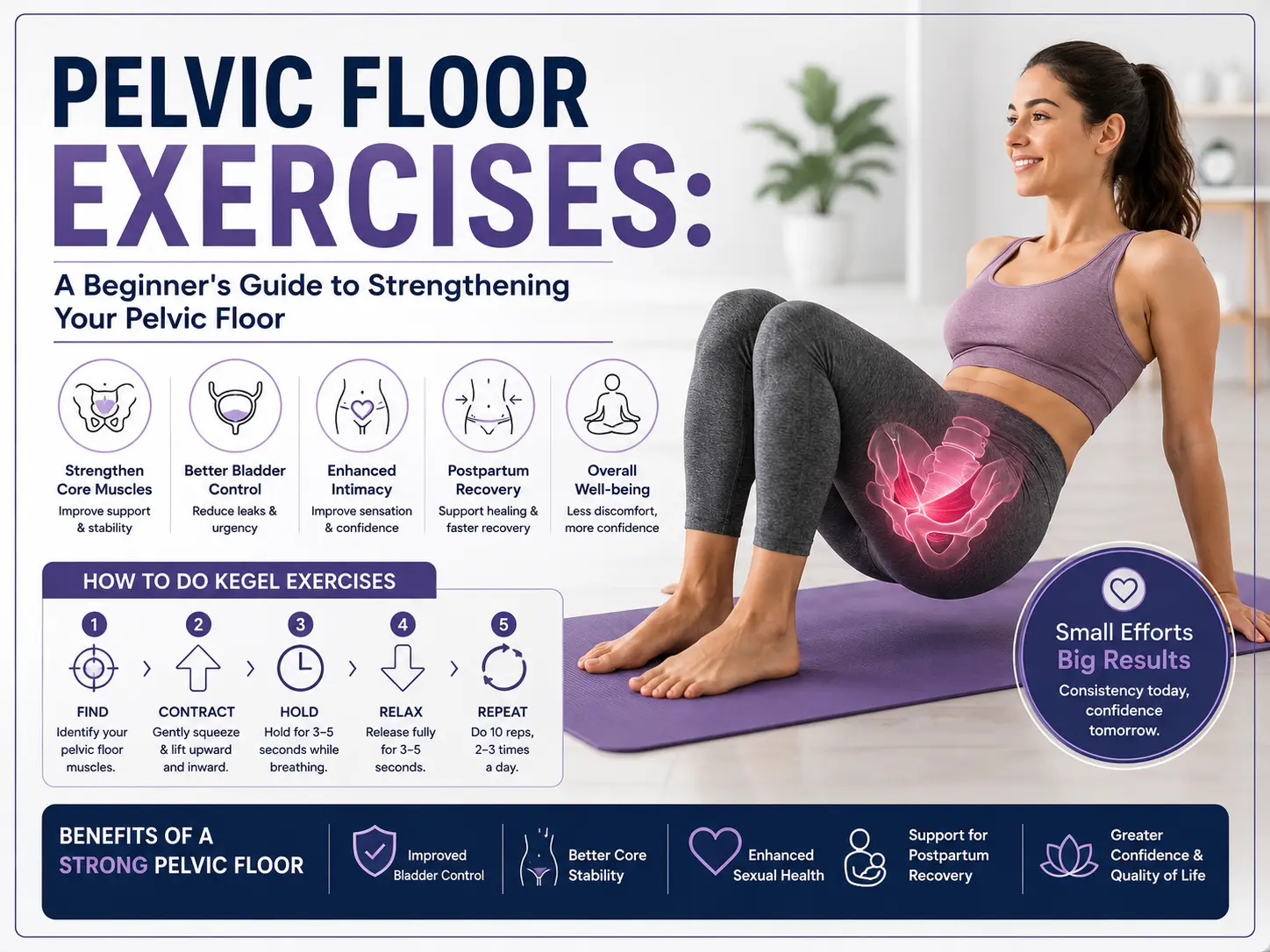
How to Do Kegel Exercises Correctly
Find the correct muscles. Use the stop-the-stream trick once, just to identify the sensation, then avoid repeating it during actual urination.
Contract. Gently squeeze the pelvic floor muscles as though lifting them upward and inward, without tensing your stomach, thighs, or glutes.
Hold. Maintain the contraction for three to five seconds if you’re just starting out, breathing normally throughout rather than holding your breath.
Relax. Fully release the muscles for the same amount of time you held the contraction, allowing a complete rest before the next repetition.
Repeat. Aim for around ten repetitions per session, working up to two or three sessions a day as your strength and awareness improve.
Benefits of Pelvic Floor Strengthening
Pelvic floor strengthening offers a handful of benefits that tend to matter to people at very different life stages, from young adults to those well into their sixties and beyond.
Muscle strength is the most direct benefit, and it builds gradually with consistent pelvic floor exercises, much like strength gains in any other muscle group. Bladder control tends to improve alongside this strength, since a stronger pelvic floor is better able to hold the urethra closed under everyday pressure like coughing or exercise.
Core support is a less obvious but genuinely important benefit. The pelvic floor works in coordination with your deep abdominal muscles to stabilize the spine and pelvis, so Kegel exercises and broader pelvic floor training can contribute to better posture and overall core function as a side effect.
Postpartum pelvic floor recovery is another area where this training matters considerably, since pregnancy and childbirth place significant strain on these muscles. Many women find that structured, consistent pelvic floor training in the months following delivery supports a smoother return to normal activity.
It’s worth being clear that individual results vary, and pelvic floor exercises work best as part of a broader approach to health rather than a guaranteed fix on their own. For persistent or more complex symptoms, professional guidance tends to produce more reliable outcomes than self-directed exercise alone.
When Should You Consider Pelvic Floor Therapy?
Home exercises work well for a lot of people, but there are situations where professional pelvic floor therapy makes a real difference, particularly when symptoms are persistent, worsening, or when someone simply isn’t sure they’re doing exercises correctly despite weeks of consistent effort.
If you’ve been practicing Kegels for a month or more without any noticeable change, that’s often a sign the technique needs adjusting rather than the exercise itself being ineffective. A therapist can assess your muscles directly and tell you, often within a single session, whether you’re actually engaging the right area.
Pelvic Floor Therapy for Beginners
For someone brand new to this, pelvic floor therapy for beginners typically starts with an assessment to determine whether your muscles are weak, tight, or uncoordinated, since the right exercises differ quite a bit depending on which of these applies. Structured, professional guidance removes a lot of the guesswork that trips people up when they’re learning alone, and it tends to shorten the time it takes to see real progress. If you want a full walkthrough of what a session actually involves, our guide on what happens during pelvic floor therapy covers the entire process in detail.
Can a Pelvic Floor Trainer Help?
A pelvic floor trainer is a device designed to support pelvic floor exercises through resistance, biofeedback, or gentle stimulation, essentially giving beginners a tool that confirms whether they’re doing things correctly rather than guessing.
These trainers can support structured pelvic floor training by removing much of the uncertainty that makes home exercise so hit or miss for beginners. Instead of hoping you’re engaging the right muscles, a device with biofeedback shows you in real time, which tends to shorten the learning curve considerably.
Choosing the appropriate device matters quite a bit here, since not every trainer suits every situation. Someone who’s very weak and struggles to consciously engage their pelvic floor might benefit more from a device with gentle electrical stimulation, while someone who already has decent muscle awareness might get more out of a resistance-based trainer that builds endurance over time.
What Are Pelvic Floor Therapy Devices?
Pelvic floor therapy devices are a broader category of tools designed to support pelvic floor training, ranging from simple resistance devices to more advanced electronic options. They differ from traditional Kegel exercises in one key way: they provide some form of external support, feedback, or stimulation, rather than relying entirely on your own sense of whether you’re doing it right.
Types of Pelvic Floor Therapy Devices
Electronic pelvic floor stimulators use mild electrical pulses to activate the pelvic floor muscles directly, which can be particularly useful for people who struggle to consciously engage these muscles on their own. The TPFHealth Electronic Pelvic Toner falls into this category, offering guided stimulation for beginners who need that initial activation support.
Kegel exercise devices typically use graduated resistance, similar to weighted balls that increase in difficulty as your strength improves. Kegel exercise balls are a common example, offering a straightforward way to build endurance over weeks and months of consistent use.
Biofeedback trainers measure your muscle activity and translate it into a visual or digital readout, so you can see exactly how strong your contraction is and whether you’re engaging the correct muscles. For beginners especially, this kind of real time confirmation tends to be one of the most valuable tools available.
Pelvic Floor Exercises vs. Pelvic Floor Therapy Devices
For beginners trying to decide where to start, it helps to see how these two approaches compare side by side.
| Pelvic Floor Exercises | Therapy Devices |
|---|---|
| Can be performed without equipment | Use specialized equipment |
| Focus on muscle control | May provide additional training support |
| Suitable for basic training | Can support structured training |
| Requires correct technique | Some devices provide feedback or stimulation |
In practice, a lot of people find the most success combining both. Starting with a device to confirm correct technique, then continuing with unassisted exercises for ongoing maintenance, tends to work better than choosing strictly one approach over the other.
How to Build a Pelvic Floor Training Routine
Start Slowly
Beginners often want to jump straight into longer holds or more repetitions, but starting with shorter, gentler sessions helps avoid overtraining a muscle group your body isn’t used to working directly.
Focus on Proper Technique
Correct engagement matters far more than intensity when it comes to pelvic floor training. A few properly performed contractions will do more for your progress than dozens of contractions using the wrong muscles.
Stay Consistent
This isn’t a muscle group that responds well to occasional effort. Aim for pelvic floor training most days of the week, even if each session is relatively short, since frequency tends to matter more than duration here.
Track Your Progress
Keeping a simple log of how many repetitions you’re doing, or noting changes in symptoms over time, helps you stay motivated and gives you something concrete to discuss if you eventually decide to see a specialist about your pelvic floor training.
Choosing the Right Pelvic Floor Trainer
A handful of factors are worth thinking through before picking a device.
Your training experience matters quite a bit here. Complete beginners often benefit most from devices with biofeedback or gentle stimulation, since these offer the most guidance, while more experienced users might prefer a straightforward resistance-based trainer.
Product type varies significantly across the category, from simple weighted devices to app-connected trainers with guided programs, so it’s worth thinking about what kind of structure and feedback actually motivates you to stay consistent.
Comfort is non-negotiable, honestly. A device that’s uncomfortable to use is a device that ends up sitting unused in a drawer, no matter how effective it might be on paper.
Ease of use matters just as much, particularly for beginners who don’t want to navigate a complicated setup process every time they want to train.
Intended purpose should guide the decision more than anything else. Someone recovering postpartum has different needs than someone managing age-related weakness, so matching the device to your specific situation tends to produce better results than choosing based on price or popularity alone.
Professional guidance, when appropriate, can help narrow down the right choice considerably. According to the American Physical Therapy Association, individualized assessment plays a meaningful role in successful pelvic floor rehabilitation outcomes, which is worth keeping in mind if you’re unsure where to start.
Frequently Asked Questions About Pelvic Floor Exercises
What are pelvic floor exercises?
They’re targeted exercises designed to strengthen the muscles supporting the bladder, bowel, and pelvic organs, most commonly performed through repeated contraction and relaxation, like Kegels.
How do Kegel exercises work?
Kegel exercises work by repeatedly contracting and relaxing the pelvic floor muscles, gradually building strength and coordination in a muscle group most people rarely engage consciously otherwise.
How often should you do pelvic floor exercises?
Most beginners are advised to practice several short sessions throughout the day, several days a week, since consistency tends to produce better results than occasional longer sessions.
Can a pelvic floor trainer help with pelvic floor training?
Yes, a pelvic floor trainer can support training by offering resistance, biofeedback, or stimulation, which helps confirm you’re engaging the correct muscles, something that’s genuinely hard to know for certain without some form of feedback.
What are pelvic floor therapy devices?
They’re a category of tools, including electronic stimulators, resistance-based devices, and biofeedback trainers, designed to support and enhance pelvic floor training beyond what unassisted exercise alone can offer.
What is the difference between pelvic floor exercises and pelvic floor therapy?
Pelvic floor exercises are something you can do independently at home, while pelvic floor therapy involves working with a trained professional who assesses your specific muscle imbalance and builds a personalized treatment plan.
Are pelvic floor exercises suitable for beginners?
Yes, pelvic floor exercises are generally well suited for beginners, though learning proper technique early on makes a significant difference in how effective the exercises end up being over time.
How do I choose a pelvic floor trainer?
Consider your current experience level, comfort, ease of use, and specific goals, and don’t hesitate to seek professional guidance if you’re unsure which type of device best fits your situation.
Final Thoughts
Starting pelvic floor training as a beginner doesn’t need to feel complicated, even though the muscle group itself is easy to overthink. A solid foundation, correct technique, consistency, and patience with a process that takes weeks rather than days, will get most people meaningfully further than jumping straight into advanced routines or expensive devices before mastering the basics.
Whether you start with simple Kegels, add a pelvic floor trainer for extra guidance, or eventually work with a therapist for a more personalized plan, the most important step is simply starting. At TherapyPelvicFloor, we offer a range of pelvic floor therapy devices designed to support beginners and experienced users alike, and our team is always happy to help if you reach out with questions about where to begin.
