
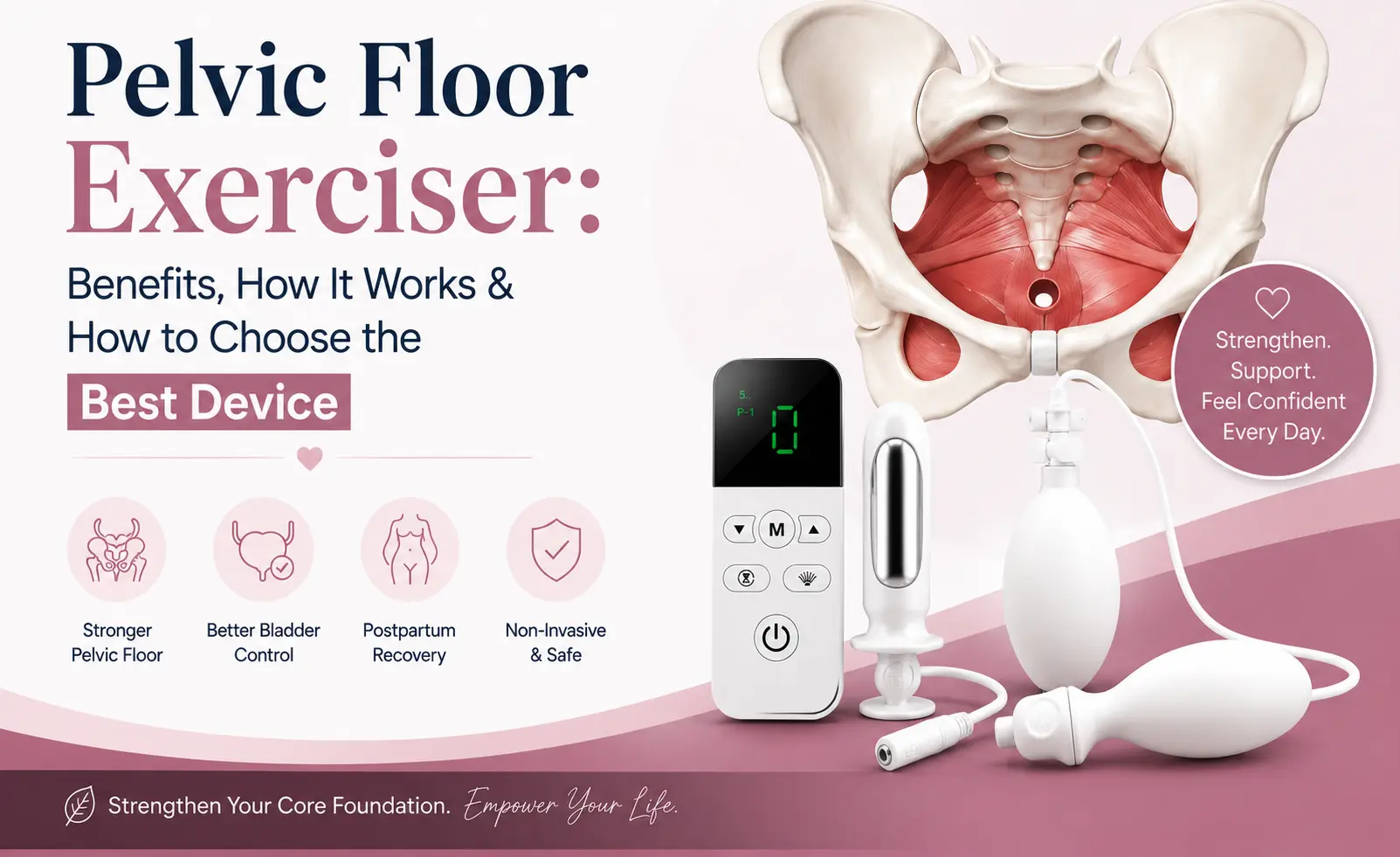
Have you ever dealt with bladder leakage, postpartum weakness, or a general sense that your pelvic muscles aren’t as strong as they used to be? You’ve probably come across the term pelvic floor exerciser. These devices have become one of the most effective, non-invasive ways to rebuild pelvic strength from home, without relying on guesswork.
A pelvic floor exerciser (sometimes called a pelvic floor trainer or pelvic floor device) targets the exact muscles responsible for bladder control, core stability, and pelvic organ support. Traditional Kegels rely entirely on your own sense of whether you’re doing them correctly. A pelvic floor therapy device removes that guesswork. It offers guidance, resistance, or stimulation to confirm your effort is going to the right place.
This guide breaks down how a pelvic floor muscle trainer works. You’ll learn who benefits most from using one, and how to choose the right device for your needs.
What Is a Pelvic Floor Exerciser?
Understanding the Pelvic Floor Muscles
Before understanding the tools, it helps to understand what they’re training. So, what is the pelvic floor in women? It’s a group of muscles and connective tissue that stretches like a supportive hammock across the base of the pelvis. This hammock holds the bladder, uterus, and bowel in place.
If you’re wondering where is the pelvic floor muscle exactly, it sits between the pubic bone at the front and the tailbone at the back. It spans the base of the pelvic cavity. These muscles control the opening and closing of the urethra, vagina, and rectum, which is why their strength directly affects bladder and bowel control. A pelvic floor muscle trainer is built specifically to engage and strengthen this muscle group in a way that’s hard to achieve through guesswork alone.
What Does a Pelvic Floor Exerciser Do?
A pelvic floor exerciser helps you locate, engage, and strengthen your pelvic floor muscles. It does this through resistance, guided feedback, or gentle electrical stimulation. Rather than hoping you’re contracting the right muscles during a manual Kegel, a pelvic floor trainer gives you a physical or digital signal confirming you’re doing it correctly. That confirmation is one of the biggest advantages over unassisted exercise.
If you’d like a broader overview first, our complete guide to pelvic floor therapy devices compares the main categories side by side.
How Does a Pelvic Floor Exerciser Work?
Muscle Strengthening
At its core, a pelvic floor strengthening device works the same way any resistance-based exercise tool does. It makes the muscles work against gentle resistance to build strength and endurance over time. Devices like Kegel weights or ball systems increase resistance gradually, similar to how you’d progress weight in strength training.
Taking this a step further, a pelvic floor muscle stimulator directly activates the muscle fibers. This is especially useful for women who struggle to consciously engage these muscles on their own.
Electrical Muscle Stimulation (EMS)
Low-level electrical currents from a pelvic floor stimulation device trigger involuntary muscle contractions. This helps activate weak or hard-to-engage pelvic floor muscles. It’s particularly helpful for people who have difficulty performing a proper voluntary contraction, a common issue after childbirth or in cases of significant muscle weakness.
Essentially, an electronic pelvic floor stimulator does some of the initial “heavy lifting.” It helps retrain the neuromuscular connection between the brain and the pelvic floor. According to the National Institute of Diabetes and Digestive and Kidney Diseases (NIDDK), pelvic floor muscle training, including electrical stimulation approaches, is a widely recommended first-line treatment for bladder control problems.
Biofeedback Technology
Pelvic floor biofeedback works by measuring muscle activity through pressure sensors or electrical signals. It translates that activity into a visual or digital readout you can see in real time. This means you know immediately whether you’re engaging the correct muscles and how strong your contraction actually is.
Biofeedback pelvic floor devices are considered one of the most effective training tools because they remove the guesswork entirely. They turn an invisible internal movement into something measurable and trackable.
Benefits of Using a Pelvic Floor Trainer
Improve Bladder Control
Strengthening the pelvic floor directly improves the muscles’ ability to keep the urethra closed under pressure. This reduces accidental leakage during coughing, sneezing, or exercise.
Support Postpartum Recovery
Pregnancy and childbirth stretch and weaken pelvic floor tissue significantly. A structured training routine helps rebuild strength, tone, and support in the months following delivery. It often speeds up recovery compared to unguided exercise alone.
Reduce Urinary Incontinence
Consistent use of a pelvic floor therapy device meaningfully reduces both stress and urge incontinence symptoms. It works by rebuilding the muscular support needed for proper bladder control. For a deeper look at the different types of leakage and how they’re treated, see our guide on urinary incontinence causes, symptoms, and treatment.
Strengthen Core & Pelvic Muscles
The pelvic floor works closely with the deep core muscles to stabilize the spine and pelvis. Strengthening this muscle group often improves overall core stability, posture, and even lower back comfort. Investing in quality pelvic floor health products isn’t just about incontinence. It’s about long-term functional strength.
Who Should Use a Pelvic Floor Therapy Device?
Women After Childbirth
Postpartum women are among the most common users. Pregnancy and vaginal delivery place significant strain on pelvic floor tissue. That tissue often needs structured rehabilitation to fully recover.
Women During Menopause
Hormonal changes during menopause thin and weaken pelvic tissue, making bladder leakage and pelvic discomfort more common. Many women look into menopause pelvic floor trainer reviews to find a device suited to this life stage. Post-menopausal muscle tissue can respond differently to training than younger tissue. It often benefits from gentler, more gradual stimulation settings.
People with Pelvic Floor Dysfunction
Pelvic floor dysfunction happens when the muscles become either too weak or too tight to function properly. This can cause pain, urgency, or incomplete emptying of the bladder or bowel. If you’re wondering how to help pelvic floor dysfunction, a combination of guided training, biofeedback, and, in some cases, professional pelvic floor physical therapy tends to offer the most reliable results.
Individuals with Weak Pelvic Floor Muscles
Not sure if this applies to you? How to know if you have a weak pelvic floor typically comes down to a few telltale signs: leakage during exercise or laughing, a frequent urge to urinate, a sensation of heaviness in the pelvic area, or difficulty fully controlling gas or bowel movements. If several of these sound familiar, a pelvic floor trainer can be a useful starting point.
Pelvic Floor Trainer vs Kegel Exerciser
Both tools aim to strengthen the same muscle group, but they work differently and suit different needs. Here’s how a pelvic floor trainer compares to a traditional kegel exerciser, kegel trainer, or kegel exercise device.
| Feature / Criteria | Pelvic Floor Trainer | Kegel Exerciser |
|---|---|---|
| Benefits | Offers guided or stimulated engagement, often with real-time feedback, making it easier to confirm you’re using the correct muscles | Builds resistance-based strength through repeated manual contractions, good for building endurance over time |
| Uses | Best for beginners, postpartum recovery, or anyone unsure how to locate or engage the right muscles | Best for those who’ve already mastered proper technique and want to build ongoing strength |
| Features | May include EMS, biofeedback, app connectivity, or adjustable intensity settings | Typically a simple weighted device, such as a kegel machine or graduated ball set, with no electronic feedback |
In many cases, the two approaches work well together. You can use a trainer to confirm correct technique early on, then transition to manual kegel exercises for ongoing maintenance. Curious where the original Kegel technique came from? Our article on Dr. Arnold Kegel, inventor of Kegel exercises covers the history behind the method still used today.
How to Choose the Best Pelvic Floor Exerciser
Comfort & Design
Look for body-safe, medical-grade silicone with a smooth, ergonomic shape. Comfort matters significantly for consistent use. A device that’s uncomfortable is a device that ends up sitting in a drawer.
Smart Features
App connectivity, progress tracking, and guided training programs can make it easier to stay consistent. They also help you see measurable improvement over time, especially if you respond well to data and visual progress.
Biofeedback
Devices with built-in biofeedback give real-time confirmation that you’re engaging the correct muscles. This significantly improves training accuracy compared to unguided exercise.
Electrical Stimulation
For users with very weak pelvic floor muscles or difficulty performing a voluntary contraction, a device with adjustable EMS settings can help. It kickstarts muscle activation before transitioning to active training.
Ease of Cleaning
Since these are internal-use devices, hygiene matters a lot. Choose easy-to-clean, non-porous materials with simple designs that avoid hard-to-reach seams or crevices. When comparing options, the best pelvic floor trainer and best kegel exerciser picks tend to share these same core qualities: body-safe materials, intuitive controls, and straightforward cleaning.
How to Use a Pelvic Floor Trainer
Knowing how to use pelvic floor trainer devices correctly makes a significant difference in results.
Step 1 – Preparation
Empty your bladder before use, and wash the device thoroughly with mild, unscented soap and warm water. Apply a water-based lubricant if needed for comfortable insertion.
Step 2 – Positioning
Lie down in a comfortable position, relax your body, and insert the device following the manufacturer’s instructions. Most devices are designed for straightforward, comfortable insertion similar to a tampon.
Step 3 – Training
Follow the guided program, whether that’s a resistance-based contraction routine, an EMS setting, or a biofeedback session. Start with shorter sessions and lower intensity, gradually increasing as your strength improves. Proper form matters just as much with a device as it does with manual Kegels. Our guide on correct posture for Kegel exercises is a useful reference for getting positioning right.
Step 4 – Cleaning & Storage
After use, clean the device thoroughly according to the manufacturer’s guidelines. Dry it completely, and store it in a clean, dry case to maintain hygiene between sessions.
Common Mistakes to Avoid
Using the Wrong Muscles
One of the most common errors is unintentionally engaging the glutes, thighs, or abdominal muscles instead of the pelvic floor. This is exactly the problem biofeedback devices are designed to solve.
Overtraining
More isn’t always better. Overtraining the pelvic floor can lead to muscle fatigue or excessive tightness. This can actually worsen symptoms like pain or urgency rather than improving them.
Inconsistent Exercise
Like any muscle group, the pelvic floor needs regular, consistent training to see lasting results. Sporadic use — a few sessions one week, then nothing for a month — significantly slows progress.
Ignoring Professional Advice
If symptoms persist, worsen, or involve pain, consult a pelvic floor physical therapist or doctor rather than relying solely on a device. Devices are a valuable tool, but they aren’t a substitute for professional evaluation when something feels off.
Frequently Asked Questions
What is a pelvic floor trainer?
It’s a device designed to help strengthen the pelvic floor muscles through resistance, electrical stimulation, or biofeedback, supporting better bladder control and pelvic stability.
Do pelvic floor exercises work?
Yes, and the research strongly supports it. Consistent pelvic floor exercise is widely recommended by doctors and physical therapists as a first-line treatment for urinary incontinence and pelvic floor dysfunction.
How do you strengthen your pelvic floor?
It comes down to consistent, correctly performed exercises, whether manual Kegels or a guided pelvic floor trainer. Ideally, you’d practice several times a week over a period of weeks to months.
How to fix a weak pelvic floor?
This typically involves a combination of targeted exercise and correct technique, often confirmed through biofeedback. Lifestyle adjustments like avoiding excessive straining help too, along with guidance from a pelvic floor physical therapist if needed.
What causes a weak pelvic floor?
The most common causes include pregnancy and childbirth, menopause-related hormone changes, chronic constipation or straining, obesity, and the natural muscle loss that comes with aging.
Can I use a pelvic floor exerciser every day?
Most devices are safe for regular use, though it’s best to follow the manufacturer’s recommended frequency and avoid overtraining. Many programs suggest sessions several times a week rather than multiple times a day.
What is the best pelvic floor trainer?
That depends on individual needs. Beginners often benefit from biofeedback-guided devices, while those with very weak muscles may benefit more from EMS stimulation before progressing to resistance-based training.
Is an electronic pelvic floor stimulator safe?
Yes, it’s generally safe for most users when used according to manufacturer instructions. However, those who are pregnant, have a pacemaker, or have certain medical conditions should consult a doctor before use.
Final Thoughts
A pelvic floor exerciser offers a practical, guided way to rebuild strength that’s difficult to achieve through guesswork alone. Whether you’re recovering postpartum, navigating menopause, or simply noticing signs of a weak pelvic floor, a well-chosen pelvic floor trainer can make a meaningful difference. It can improve bladder control, core stability, and overall pelvic health.
From EMS-based stimulation to biofeedback-guided training, today’s pelvic floor therapy device options make it easier than ever to target these muscles accurately and consistently. A pelvic floor muscle stimulator or pelvic floor strengthening device can be a great starting point, especially if you’ve struggled to feel confident doing manual Kegels alone.
If you’re ready to start strengthening your pelvic floor with the right support, explore our full range of pelvic floor therapy devices. This includes the TPFHealth Electronic Pelvic Toner and Kegel exercise balls, to help you find the best pelvic floor trainer for your needs. Or get in touch with our team if you’d like personalized guidance. If you’re experiencing persistent pelvic floor dysfunction that hasn’t improved with home exercise, we’d always recommend consulting a healthcare professional as well.
